Growing up in the Loire Valley, rillettes were never just a food they were a ritual. A pot of rillettes on the table meant Sunday lunch, family gatherings, a market morning with my grandmother in Tours. For me, there is no more honest or comforting product in all of French charcuterie.
When most people outside France think of rillettes, they picture a pot of rich, spreadable pork — the classic from the Loire Valley. And while pork rillettes are indeed the undisputed king, the world of French rillettes is far broader and more diverse than most people realise. From duck to rabbit, from salmon to sardines — France produces a remarkable range of rillettes, each with its own character, regional roots, and ideal pairings.
In this complete guide, I take you through every type of French rillettes you need to know meat, poultry, and fish. Let’s go.
What Makes Something a Rillette?
Before diving into the different types, it’s worth understanding what defines a rillette. The term refers to a specific preparation method not just an ingredient.
True rillettes are made by slow-cooking meat (or fish) in fat at a very low temperature for several hours, until it becomes tender enough to be shredded by hand and blended into a spreadable texture. The result is always:
- Coarse and textured unlike smooth pâté, rillettes retain visible shreds of meat
- Rich and unctuous generously enriched with the cooking fat
- Served at room temperature never cold, never hot. This is essential.
- Preserved the fat acts as a natural sealant, extending shelf life considerably
One thing I always insist on: rillettes and pâté are not the same thing. Pâté is ground, emulsified, and baked. Rillettes are slow-cooked and hand-shredded always rougher, always more rustic, always more honest. Remember this distinction and you will earn instant respect from any French person.
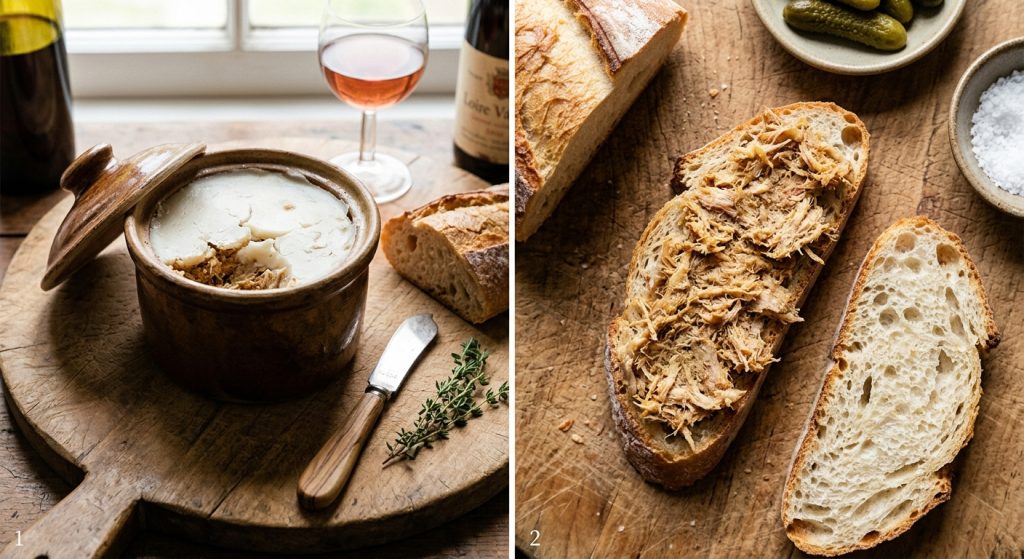
Part 1 : Pork Rillettes: The Heart of the Tradition
Pork rillettes are the original, the benchmark, the reference against which all others are judged. The tradition was born in the Loire Valley my home and it is here that the finest pork rillettes in the world are still produced today.
Rillettes de Tours IGP : The Reference
I may be biased Tours is my city but Rillettes de Tours are objectively the finest pork rillettes in France, and the only ones to hold an IGP label. This certification guarantees that they are produced in the Tours area following a strict traditional method that has not changed in centuries.
What makes them truly distinctive and this is something I want to be precise about is that the pork is slow-cooked in its own fat, rendered naturally during the long cooking process. No lard is added from outside. The pork pieces cook for 4 to 6 hours at very low temperature until they give up their own fat, which then becomes the cooking medium and the preserving agent. The result is shredded by hand and seasoned simply with salt, pepper, and a touch of nutmeg.
The texture is firmer and drier than other pork rillettes almost grainy which is precisely what defines them. If you find rillettes that are silky and very smooth, they are not from Tours.
- Texture: firm, textured, almost grainy this is the signature of Tours
- Flavor: deep, concentrated pork flavor, simply seasoned, with a slightly rustic character
- Cooking fat: the pig’s own fat, rendered during slow cooking no added lard
- Best with: fresh baguette, salted butter, cornichons nothing more needed
- Wine pairing: Chinon rouge or Vouvray sec the Loire Valley combination is perfect
Rillettes du Mans — The Great Rival
Le Mans , famous internationally for its 24-hour motor race is equally famous in the Loire Valley for its rillettes. The debate between Tours and Le Mans rillettes is one of France’s great, friendly culinary rivalries, and I have to admit that Mancelles rillettes have their own considerable charm.
The key difference: Rillettes du Mans are cooked longer and with more fat, resulting in a softer, richer, more spreadable consistency. Where Tours rillettes are firm and grainy, Le Mans rillettes are smooth and almost silky. Neither is better — they are simply different expressions of the same tradition.
- Texture: softer and more spreadable than Tours , almost silky
- Flavor: richer, more fat-forward, deeply unctuous
- Best with: toasted sourdough or a slice of warm brioche
- Wine pairing: Muscadet sur Lie or a light Gamay
Rillettes du Poitou : The Forgotten Sister
Often overlooked in conversations about French rillettes, the Rillettes du Poitou deserve far more recognition than they receive. Produced in the Poitou region , just south of the Loire Valley they represent a third, distinct style that sits between Tours and Le Mans.
What makes them distinctive is their very fine texture more so than both Tours and Le Mans and a higher fat content that makes them almost melt on the tongue. They are also traditionally seasoned with a slightly more generous hand, with more pepper and sometimes a hint of local white wine.
- Texture: very fine and smooth the most refined of the Loire Valley pork rillettes
- Flavor: rich and generously seasoned, with subtle white wine notes
- Best with: thin slices of toasted baguette or country bread
- Wine pairing: Haut-Poitou blanc or a dry Chenin Blanc
Rillettes d’Anjou : The Balanced Middle Ground
From the Anjou region, just west of Tours along the Loire river, these rillettes occupy a pleasant middle ground between the firmness of Tours and the richness of Le Mans. Well-seasoned and consistently excellent at local markets, they are the everyday rillettes of the western Loire Valley.
Part 2 : Poultry Rillettes: Duck, Goose and Rabbit
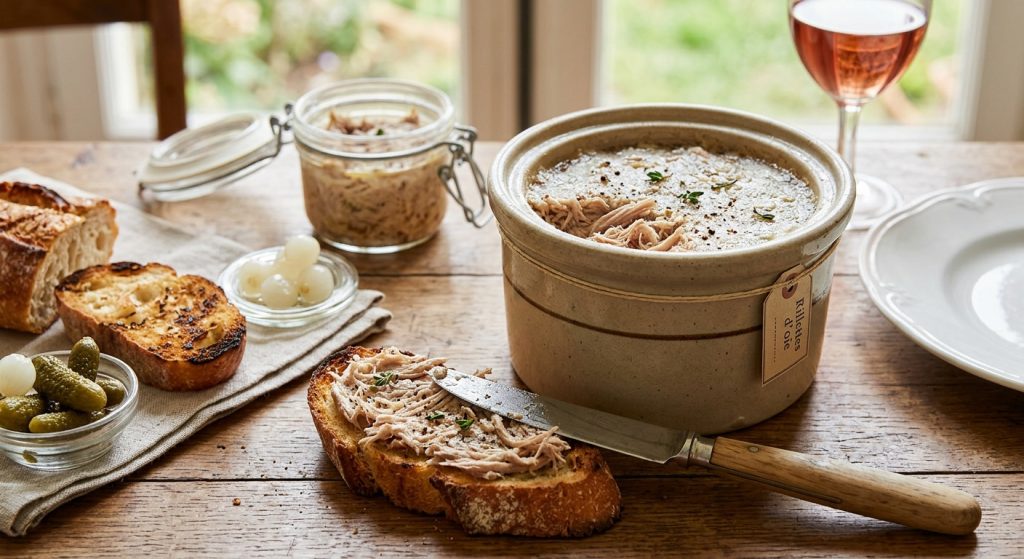
Beyond pork, France produces exceptional rillettes from other meats most notably duck, goose, and rabbit. These are not modern inventions or substitutes; they are genuine regional traditions with centuries of history.
Rillettes de Canard : Duck Rillettes
Duck rillettes are the most popular alternative to pork, and for good reason. In southwest France the Périgord, Gascony, the Landes duck is not just an ingredient, it is a way of life. The duck rillettes from this region are made from duck legs slow-cooked in duck fat one of the most flavourful and noble cooking fats in all of French cuisine.
The result is richer and more intensely flavoured than pork rillettes, with a slightly gamey depth that duck lovers find irresistible. The duck fat gives them a silky quality that is unlike anything a pork rillette can achieve.
- Texture: silky and smooth, slightly softer than pork rillettes
- Flavor: rich, intense duck flavor with subtle gamey depth not for timid palates
- Cooking fat: pure duck fat do not compromise on this
- Best with: toasted sourdough, a spoonful of fig jam or onion confit, and cornichons
- Wine pairing: Cahors, Madiran, or a robust Côtes du Rhône
- Regional home: Périgord, Gascony, Landes the great duck country of southwest France
My tip: duck rillettes are particularly wonderful with a small spoonful of fig jam on the side. The sweetness balances the richness of the duck beautifully this combination is standard in any good restaurant in the Périgord.
Rillettes d’Oie : Goose Rillettes
Rillettes d’oie are rarer, more expensive, and more luxurious than duck rillettes produced primarily in southwest France and Alsace, where geese are traditionally raised for foie gras production. The rillettes are made from the remaining goose meat cooked in goose fat considered by many French cooks to be the most refined of all animal fats.
- Texture: exceptionally smooth and luxurious the finest textured rillettes of all
- Flavor: delicate, refined, with a subtle sweetness that distinguishes goose fat from all others
- Best with: toasted brioche or thin melba toast this deserves elegant accompaniments
- Wine pairing: Alsatian Riesling or a dry Gewurztraminer
- Occasion: Christmas, New Year, special celebrations this is a festive product
Rillettes de Lapin : Rabbit Rillettes
Rabbit rillettes are a wonderful option for those who find pork or duck rillettes too rich. Rabbit is a naturally lean meat, giving the rillettes a lighter texture and more delicate flavor. They are enriched with pork fat to achieve the characteristic spreadable consistency , but remain the lightest of all meat rillettes.
Rabbit rillettes have a particularly strong tradition in the Loire Valley in Touraine, Berry, and the Sologne, where rabbit hunting has been part of rural life for centuries. In the Sologne especially, rabbit rillettes made from wild rabbit are considered a true regional treasure.
- Texture: lighter and more delicate than pork or duck the least fatty of all meat rillettes
- Flavor: mild, slightly sweet rabbit flavor with herbal notes of thyme and bay leaf
- Best with: fresh baguette and a strong Dijon mustard the mustard is essential
- Wine pairing: light Pinot Noir from Bourgogne, or a dry Sancerre blanc
- Regional home: Touraine, Berry, Sologne — the rabbit country of central France
Part 3 : Fish Rillettes: France’s Best-Kept Secret
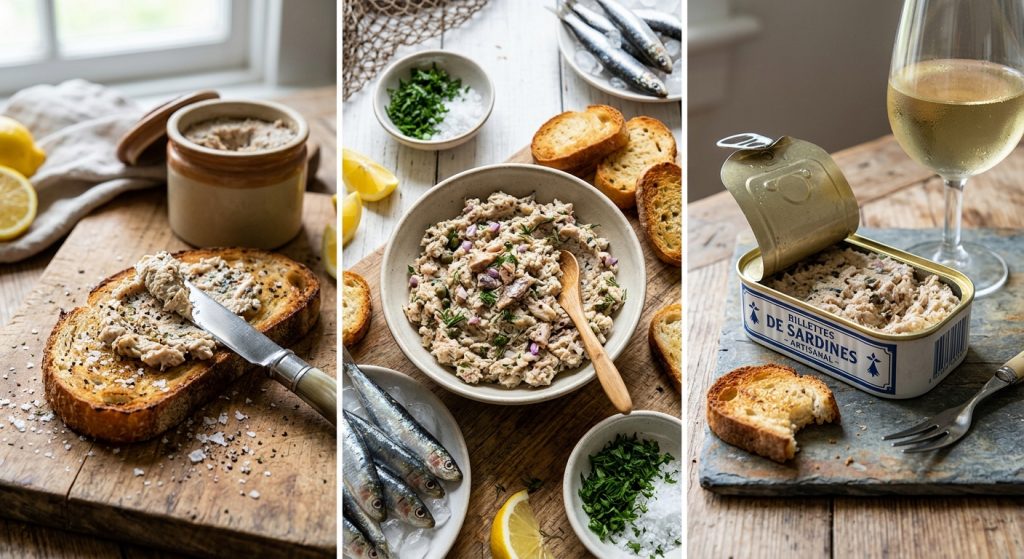
This is the section that surprises most people outside France and it is perhaps my favourite to write about, because fish rillettes are so little known internationally yet so deeply embedded in French coastal food culture.
The principle is the same as meat rillettes slow cooking, shredding or flaking, and blending with fat but the results are lighter, fresher, and completely different in character. Fish rillettes are not a modern invention or a health-conscious substitute for meat: they are a genuine French tradition, rooted in the fishing communities of Brittany, the Atlantic coast, and the rivers of the Loire Valley.
Rillettes de Saumon :Salmon Rillettes
Rillettes de saumon are today the most widely consumed fish rillettes in France found in every supermarket, every traiteur, and on the menu of every modern French bistro. They emerged in the second half of the 20th century as French chefs applied the rillettes technique to fish, and quickly became a national staple.
The classic preparation combines freshly poached salmon with a portion of smoked salmon, blended with crème fraîche, lemon juice, fresh dill, and sometimes a touch of cream cheese. The result is light, fresh, and elegant a perfect summer apéritif spread.
- Texture: smooth and creamy, with some visible salmon flakes for texture
- Flavor: fresh salmon balanced with lemon, dill, and the smokiness of the smoked salmon
- Fat base: crème fraîche and/or cream cheese lighter than meat rillettes
- Best with: thin toasted bread, blinis, or cucumber rounds
- Wine pairing: Chablis, Sancerre blanc, or a dry Alsatian Pinot Gris
- Perfect for: summer apéritifs, elegant starters, light lunches
My note: the Loire river was historically one of France’s great salmon rivers, before the construction of dams in the 20th century. Rillettes de saumon have a genuine Loire Valley connection and remain enormously popular in Tours and the surrounding region.
Rillettes de Sardines : The Pride of Brittany
If salmon rillettes are the elegant option, then sardine rillettes are the bold, proud, unapologetic option and I love them for it. Brittany has been canning sardines since the 19th century, and the sardine rillettes from this region are a direct product of that great tradition.
Made from quality Breton sardines ideally from Quiberon or Concarneau blended with salted Breton butter, lemon, and fresh herbs, they are intensely flavoured, briny, and deeply satisfying. This is not a product for those who like things mild.
- Texture: smooth and spreadable with some visible fish texture
- Flavor: bold, briny, intensely sardine assertive and proud
- Fat base: salted Breton butter essential for authenticity
- Best with: thick slices of dark rye bread or traditional Breton biscuit bread
- Wine pairing: Muscadet sur Lie the Breton pairing par excellence
- Or: a crisp Breton cider perhaps even better than wine with sardines
- Regional home: Brittany particularly Quiberon, Concarneau, and the Morbihan coast
Rillettes de Thon : Tuna Rillettes
Rillettes de thon are France’s great everyday pantry staple simple, accessible, and enormously popular as a quick lunch or picnic spread. Do not underestimate them. Made well, with good-quality tuna, proper crème fraîche, capers, lemon, and fresh herbs, they are genuinely delicious not a compromise but a real pleasure.
- Texture: smooth with visible tuna flakes
- Flavor: savory, slightly briny, fresh with lemon and capers
- Fat base: crème fraîche or cream cheese
- Best with: baguette, crackers, or raw vegetable sticks for dipping
- Wine pairing: Provence rosé or a crisp Picpoul de Pinet
- Good for: picnics, quick weekday lunches, children’s apéritifs
Rillettes de Maquereau : Mackerel Rillettes
Rillettes de maquereau are perhaps the most underrated fish rillettes in France and I say this with some frustration, because they deserve far more attention than they receive. Mackerel is an extraordinarily flavourful, nutritious, and sustainable fish, and it lends itself beautifully to the rillettes treatment.
The natural oils of the mackerel largely replace the need for added fat making these rillettes naturally rich and spreadable. They are most commonly made with smoked mackerel, which adds a wonderful depth of flavor.
- Texture: naturally rich and spreadable the fish oils do the work
- Flavor: bold, smoky, assertive , with mustard and lemon to balance
- Fat base: the fish’s own natural oils , very little added fat needed
- Best with: dark rye bread or wholegrain crackers ,substantial bread for a substantial spread
- Wine pairing: Entre-deux-Mers blanc or a dry Alsatian Sylvaner
Rillettes de Truite : Trout Rillettes
A personal favourite that deserves wider recognition — rillettes de truite are a speciality of the rivers and streams of central France, particularly in the Auvergne and the upper Loire Valley. Made from freshwater trout slow-cooked and blended with crème fraîche and fresh herbs, they are delicate, fresh, and extraordinarily elegant.
- Texture: delicate and light, with a fine, almost mousse-like quality
- Flavor: fresh, clean, subtly sweet trout flavor with dill and lemon
- Best with: thin toasted bread or cucumber rounds
- Wine pairing: a dry Vouvray or a mineral Saint-Pourçain blanc
- Regional home: Auvergne, upper Loire Valley, and the rivers of central France
Quick Guide: Which Rillettes Should You Try First?
Here is my personal guide — as a Loire Valley native who has eaten rillettes all his life:
- You want the authentic French experience → Rillettes de Tours IGP. Non-negotiable.
- You prefer something softer and richer → Rillettes du Mans.
- You want something lighter in meat → Rabbit rillettes — especially from the Sologne.
- You want the most luxurious option → Goose rillettes. For a special occasion.
- You prefer duck → Rillettes de canard with fig jam. Southwest France knows best.
- You want a fish option, mild → Salmon rillettes with a glass of Chablis.
- You want a fish option, bold → Sardine rillettes from Brittany with a Muscadet.
- You want something for everyday → Tuna rillettes. Simple, honest, good.
- You want to discover something new → Trout or mackerel rillettes. You won’t regret it.
Frequently Asked Questions
What is the difference between Rillettes de Tours and Rillettes du Mans?
Both are made from slow-cooked pork in the Loire Valley, but the key differences are texture and fat content. Tours rillettes are cooked in the pig’s own rendered fat, resulting in a drier, firmer, almost grainy texture and they hold an IGP label. Le Mans rillettes are cooked longer with more fat, producing a smoother, richer, more spreadable result. Neither is better ,they are different traditions from neighbouring cities with a proud culinary rivalry.
Are rillettes the same as pâté?
Absolutely not and this confusion irritates every French charcutier. Pâté is ground meat emulsified and baked in a mold, producing a smooth, sliceable result. Rillettes are made by slow-cooking whole pieces of meat in fat, then shredding them by hand always coarser, always more textured, always more rustic. The preparation and result are fundamentally different.
Can rillettes be frozen?
Yes , all meat rillettes freeze well for up to 3 months. Defrost slowly in the fridge overnight and bring to room temperature before serving. Fish rillettes are best consumed fresh and do not freeze as well — the texture can become watery on thawing.
Why must rillettes always be served at room temperature?
Because cold kills the flavor. At refrigerator temperature, the fat solidifies, the texture becomes dense and unpleasant, and most of the aromatic compounds that give rillettes their character are locked away. At room temperature around 18-20°C , the fat softens, the texture opens up, and the full flavor reveals itself. Always take your rillettes out of the fridge at least 20-30 minutes before serving. This single step will transform your rillettes experience.
Final Thoughts
The world of French rillettes is richer, more diverse, and more fascinating than almost anyone outside France realises. From the firm, honest Rillettes de Tours IGP to the bold sardine rillettes of the Breton coast — each variety tells a story about its region, its people, and its ingredients.
My advice: start with the classic. Find the best Rillettes de Tours IGP you can, spread them generously on a fresh baguette with salted butter and cornichons, pour yourself a glass of Chinon rouge, and take your time. Then explore. The journey through French rillettes is one of the most rewarding in all of French food culture. Bon appétit!