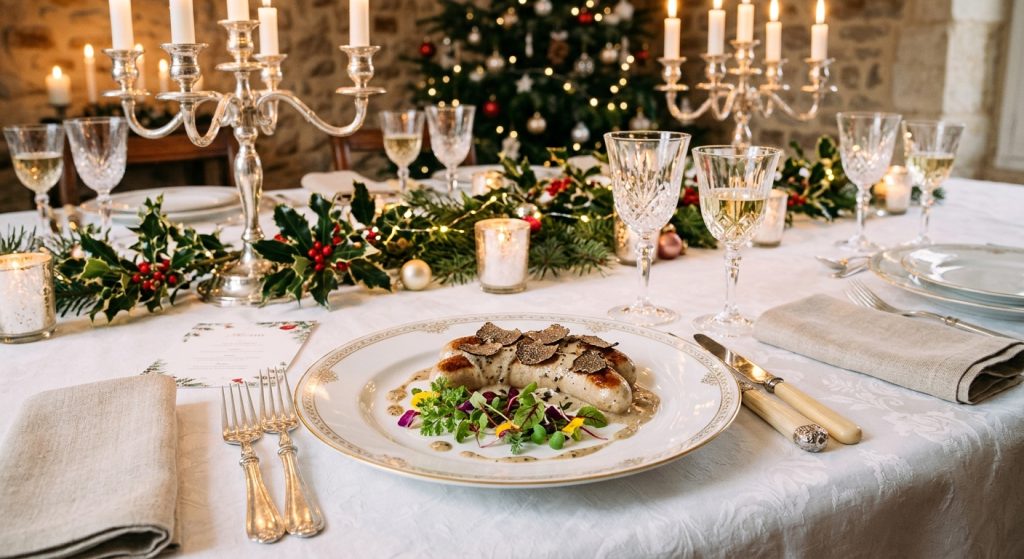
Every year around the 20th of December, something changes in the windows of French butchers. Among the salamis and the jambon de pays and the andouillettes, there appears an entirely new product pale, delicate, dressed in its white natural casing that announces the imminent arrival of Christmas more clearly than any decoration or carol. Boudin blanc has arrived.
If boudin noir is the bold, ancient, iron-willed elder of the boudin family, boudin blanc is the refined younger sibling subtle, elegant, demanding, and in its finest expressions, one of the most technically challenging products in all of French charcuterie.
I have been studying boudin blanc for longer than I care to admit. It is a product that seduced me slowly I came to it through boudin noir, dismissing it initially as the “lesser” version. I was wrong, and spectacularly so. Boudin blanc demands as much skill, as much knowledge, and as much passion as its darker cousin. It simply channels them differently.
What Is Boudin Blanc? Understanding the Pale Sausage
Boudin blanc is a cooked white sausage made without blood. The base is white meat typically pork, veal, chicken, or a combination combined with cream, eggs, and aromatics, then stuffed into a natural pork casing and gently cooked. The result is a sausage of extraordinary delicacy, with a pale ivory color, a smooth, yielding texture, and a flavor that is simultaneously rich and subtle.
What distinguishes boudin blanc from other white sausages from bratwurst, from weisswurst, from the various white sausages of European charcuterie is the high proportion of cream and eggs in the recipe. These give boudin blanc its characteristic silky texture and its ability to hold a gentle, quivering interior that collapses luxuriously on the tongue. This is not a sausage you bite through; it is a sausage you press gently with a fork, feeling the casing give, watching the creamy interior emerge.
The protein content is relatively low compared to other sausages this is not designed to be filling, to provide fuel, to sustain you through a working day. Boudin blanc is designed to delight, to seduce, to make the person eating it pause mid-bite and pay attention. It is luxury sausage, and should be treated as such.
The History of Boudin Blanc: From Royal Tables to Christmas Tradition
Boudin blanc has a more aristocratic history than boudin noir. While blood sausage was peasant food practical, economical, using parts of the pig that would otherwise be discarded boudin blanc was from the beginning a product for those who could afford veal, cream, and eggs in generous quantities.
Medieval French court records include references to a pale sausage made with white meats and cream served at banquets, and by the 17th century, boudin blanc had established its association with Christmas celebrations. The timing makes perfect sense: December was when animals were slaughtered before winter, when cream was available in relative abundance, and when the cold weather made the delicate product’s preparation and keeping more reliable.
By the 19th century, the Christmas boudin blanc tradition was firmly established across France. Parisian charcutiers developed ever more refined recipes, some incorporating truffles, foie gras, or other luxury ingredients to cater to the wealthy clientele seeking the most prestigious réveillon table. This tradition of luxury boudin blanc continues today in France’s great charcuteries and starred restaurants.
The Great Regional Boudins Blancs
Boudin Blanc de Lyon :The Gold Standard
If Mortagne-au-Perche is the capital of boudin noir, Lyon is unquestionably the capital of boudin blanc. The Lyonnaise tradition of boudin blanc is ancient, refined, and jealously maintained. The classic Lyonnaise recipe uses pork and veal (or sometimes chicken breast), combined with cream, eggs, and onions seasoned with salt, white pepper, and occasionally truffle. The result is a product of extraordinary smoothness and delicacy.
The great “boudiniers” of Lyon the charcutiers who specialize exclusively in boudin production are legendary figures in the city’s food culture. Names like Reynon and Sibilia have produced boudin blancs that are discussed and debated with the same reverence that wine enthusiasts reserve for great Burgundy. Visiting Lyon in December without eating boudin blanc from a great charcutier is, in my opinion, a missed opportunity of the highest order.
Boudin Blanc de Rethel (Ardennes) : Protected by Law
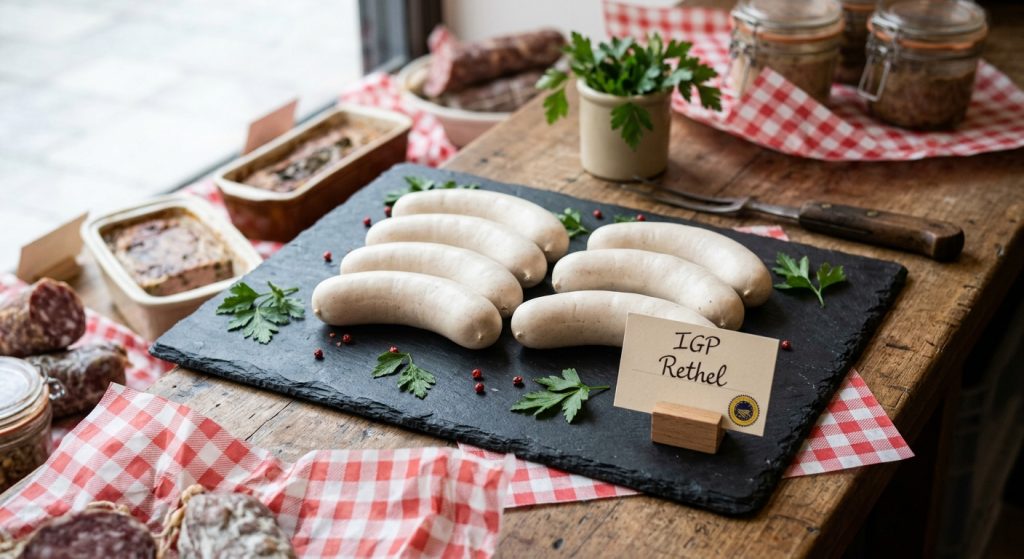
The boudin blanc de Rethel, from the Ardennes department, holds an Indication Géographique Protégée (IGP) a European protected geographical indication. This is an extremely unusual distinction for a boudin blanc and speaks to the product’s quality and the community’s commitment to protecting its tradition.
What distinguishes the Rethel version is its simplicity and its legal restrictions: the recipe may contain ONLY pork, pork fat, eggs, milk, onions, salt, and pepper. No cream, no other meats, no additional ingredients. The IGP rules specify not just the ingredients but the proportions, the method of preparation, and the geographic area of production. This legislative protection of a charcuterie recipe is remarkable and reflects how seriously the French take their regional food traditions.
Boudin Blanc Truffe : Luxury Without Apology
In the great charcuteries of Paris, Lyon, and Périgueux, the most prestigious boudin blanc is the version incorporating black Périgord truffle (Tuber melanosporum). Small pieces of truffle are folded into the meat mixture, perfuming the entire sausage with their extraordinary underground aroma. When cooked, the truffle flavor permeates the cream and egg mixture with a depth that is simply unforgettable.
I ate my first truffle boudin blanc at a Christmas dinner in the Dordogne, in a farmhouse where the host had made it himself with truffles collected that morning from his own oak grove. It remains one of the finest things I have ever eaten. The combination of the delicate, creamy sausage with the earthiness of fresh truffle is a masterclass in complementary flavors.
Boudin Blanc Beyond Metropolitan France: The DOM-TOM Variations
Boudin blanc has found its way into the culinary traditions of France’s overseas territories, adapted to local tastes and ingredients with fascinating results.
In Martinique and Guadeloupe, a version of boudin blanc exists alongside the more famous boudin créole. Made with pork and chicken, seasoned with local aromatics but with a gentler spice profile than the boudin noir version, the Antillean boudin blanc is typically eaten at special celebrations , weddings, communions, Christmas réveillon , rather than as everyday food.
In La Réunion, the white boudin tradition incorporates local aromatics including vanilla from the island’s legendary vanilla production, giving some versions a sweetly perfumed note that is entirely unique. The Réunionese boudin blanc, when it incorporates a trace of local vanilla, is one of those food experiences that simply cannot be replicated anywhere else in the world.
Competitions and Honors: Boudin Blanc in the Arena
Boudin blanc has its own competitive world, though it is less organized than the boudin noir circuit centered on Mortagne-au-Perche.
The Concours Général Agricole in Paris includes boudin blanc in its charcuterie categories, and a gold medal from this competition is among the highest honors available for any French food product. The judging criteria for boudin blanc focus on texture (the critical silky smoothness), color (uniformly pale ivory with no gray patches), aroma (delicate, clean, milky), and flavor (balanced between the sweetness of cream and the savory notes of seasoned meat).
The Confrérie des Chevaliers du Goûte-Boudin in Mortagne-au-Perche, while primarily focused on boudin noir, includes boudin blanc as a competition category at its annual Foire. The Confrérie’s endorsement carries weight even for the white version, reflecting the organization’s authority across the entire boudin universe.
Various regional competitions in Lyon, Périgueux, and other cities with strong boudin blanc traditions also take place throughout December, typically coinciding with the Christmas market season when the product is at the peak of its commercial and cultural importance.
Buying and Cooking Boudin Blanc: My Practical Guide
Boudin blanc demands more careful handling than boudin noir. Its delicacy is also its vulnerability.
Buying
Always buy from a charcutier rather than a supermarket if at all possible. Good boudin blanc should be absolutely uniform in color pale ivory throughout, with no gray or brown patches that suggest age. The casing should be unbroken and slightly moist. Ask when it was made: boudin blanc is best eaten within two days of production. Some charcutiers make theirs on December 24th specifically for réveillon dinner.
The Critical Step: Removing the Casing
Here is something that divides French households every Christmas: do you remove the casing before or after cooking? My firm position, after many years of testing, is this: cook it in the casing, then remove the casing at the table. The casing protects the delicate filling during cooking and preserves the sausage’s shape. But eating the casing itself tough and chewy against the silky interior , is a distraction from the pleasure.
Cooking Methods
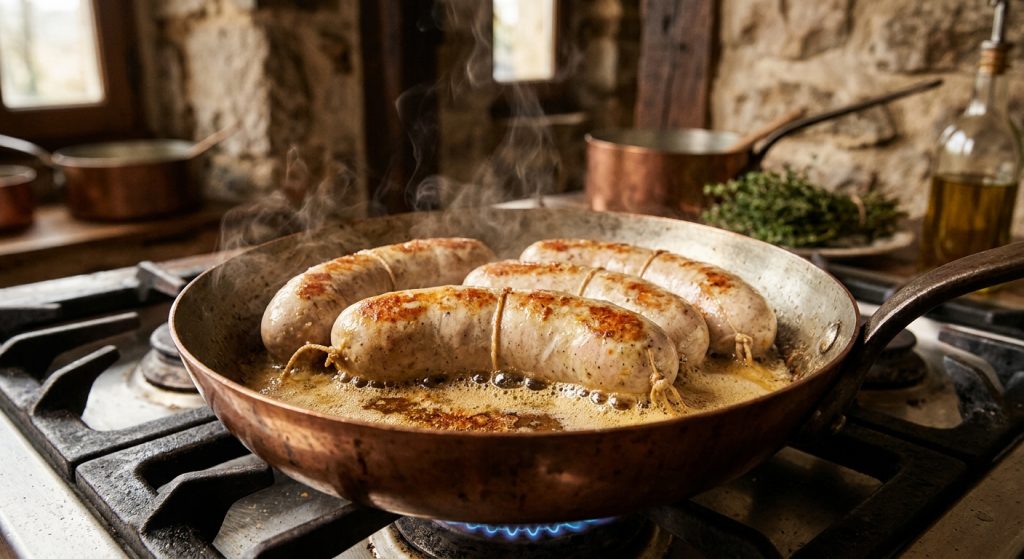
Pan-fried in butter: Melt good butter in a pan over medium-low heat. Add the boudin blancs, do not prick them and cook gently for about 12-15 minutes, turning carefully to avoid splitting. The exterior should be golden, not brown. This is the classic method.
Oven-baked: At 160°C (fan oven) for 20-25 minutes, with a small knob of butter on each. Excellent for cooking large quantities for a Christmas dinner party allows you to focus on other elements of the meal.
Poached then pan-fried: Some Lyonnaise charcutiers recommend poaching the boudin in simmering (not boiling) water for 8 minutes, then finishing in butter for 5 minutes. This produces the most silky interior of all methods, at the cost of some exterior color.
Classic Accompaniments
Boudin blanc’s delicacy calls for accompaniments that complement without overpowering. The Lyonnaise tradition pairs it with a simple tossed salad, a glass of Beaujolais or light white wine, and good bread. For Christmas réveillon, baked apples stuffed with brown sugar and butter, or a purée of potato and celery root, are excellent partners. Truffle boudin blanc needs nothing more than a spoonful of potato purée made with exceptional cream and butter to let the truffle speak.
The Poetry of Pale Sausage: A Final Word
Boudin blanc is perhaps the most French of all French charcuterie. Not because it is the most robust or the most ancient or the most technically complex though it is considerably complex but because it embodies the French culinary value that is hardest to explain to foreigners: the value of restraint.
Great boudin blanc achieves its effect not through bold flavors and strong seasoning but through the absence of anything unnecessary. The cream, the white meat, the eggs, the gentle spicing each element present for a reason, each in precisely the right proportion. Nothing more, nothing less. It is cooking as discipline, charcuterie as philosophy.
When you eat boudin blanc really eat it, with attention you understand why it has graced the Christmas tables of French families for centuries. It is not merely food. It is a seasonal ritual, a marker of celebration, a way of saying: this moment matters, this meal matters, this table and the people around it matter.
That is why we eat boudin blanc at Christmas. Not just because it is delicious though it is, extraordinarily so but because it reminds us what the season is for.