One of the things that fascinates me most about French charcuterie is its apparent simplicity. A saucisson sec contains just a handful of ingredients — pork, salt, pepper, perhaps a touch of garlic. A jambon de Bayonne needs nothing more than pork and salt. And yet the results are extraordinarily complex, deeply flavourful, and utterly unique.
How is that possible? The answer lies in the quality of each ingredient, the precise way they interact, and the time and environment in which that interaction takes place. In this guide, I take you through every ingredient used in traditional French charcuterie — what it is, what it does, and why it matters.
1. The Meat : The Foundation of Everything
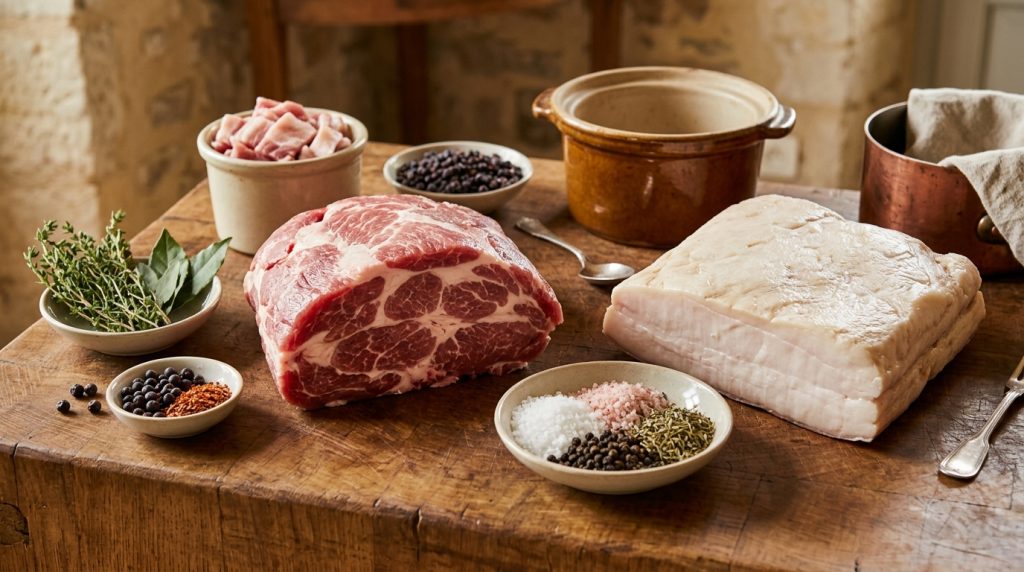
Everything begins with the meat. In French charcuterie, the quality, breed, and diet of the animal is not a secondary consideration it is the primary one. A mediocre piece of pork cannot be transformed into a great saucisson, no matter how skilled the charcutier.
Pork :The Undisputed King
The vast majority of French charcuterie is made from pork and this is no accident. The pig is uniquely well-suited to charcuterie production for several reasons:
- Its fat profile is ideal for curing with a natural balance of saturated and unsaturated fatty acids that preserves well and develops complex flavors during aging.
- Every part of the pig can be used nothing is wasted. The shoulder becomes saucisson, the belly becomes lardons, the leg becomes ham, the intestines become casings, the liver goes into pâté, the head into fromage de tête.
- The fat is flavourful and versatile pork fat can be rendered for cooking (lard), used as a casing coating, or incorporated directly into the product.
For the finest charcuterie, the breed of pig matters enormously. Heritage breeds like the Noir de Bigorre, the Pie Noir du Pays Basque, and the Gascon pig produce meat with a fundamentally different fat profile richer in oleic acid (like olive oil), with deeper, more complex flavour than commercial breeds.
Other Meats Used in French Charcuterie
While pork dominates, French charcuterie also uses a range of other meats, each bringing its own character:
- Duck and goose central to the charcuterie of southwest France. Duck and goose legs become confit and rillettes; their livers become foie gras; their fat is used as a cooking and preserving medium.
- Rabbit used for rillettes and terrines in the Loire Valley, Berry, and Sologne regions. Naturally lean, it is always enriched with pork fat.
- Wild boar (sanglier) used in terrines and pâtés, particularly in hunting regions like the Sologne, Ardennes, and Auvergne. More assertive in flavor than domestic pork.
- Veal used in refined terrines and galantines, particularly in Parisian charcuterie tradition.
- Game birds pheasant, partridge, and woodcock appear in seasonal terrines in hunting regions.
- Offal liver, kidney, heart, and tongue are central to many traditional products. Liver is essential for pâté; tongue is used in pressed products like langue en gelée.
2. Salt — The Most Important Ingredient of All
If I had to name the single most important ingredient in French charcuterie, it would not be the pork — it would be the salt. Salt is not just a seasoning in charcuterie; it is the fundamental preservation mechanism, the flavor foundation, and in some cases, a product of terroir in its own right.
What Salt Does in Charcuterie
- Draws out moisture through osmosis, salt pulls water out of the meat cells, reducing the water activity that bacteria need to survive.
- Creates an inhospitable environment for harmful bacteria at the right concentration, salt prevents the growth of dangerous pathogens like Listeria and Salmonella.
- Denatures proteins salt changes the structure of meat proteins, affecting texture and water-binding capacity.
- Develops flavor during the long curing and aging process, salt interacts with the meat’s proteins and fats to develop complex flavor compounds.
- Acts as a preservative historically, salt was the only way to preserve meat through winter. In charcuterie, it remains the primary preservation tool.
The Great French Salts of Charcuterie
Not all salts are equal in French charcuterie and the choice of salt is often a defining element of a product’s regional identity:
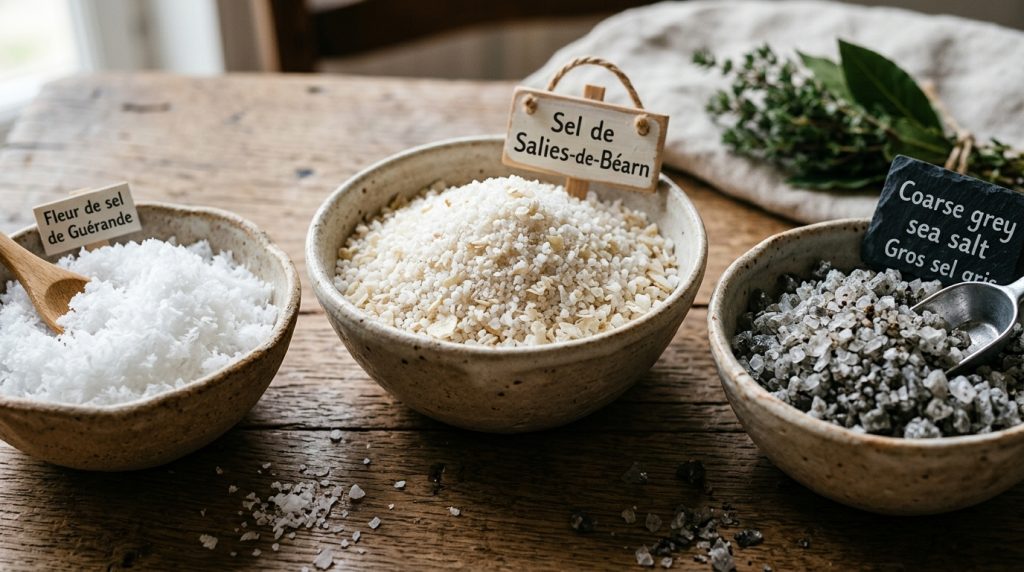
- Sel de Salies-de-Béarn ,the legendary salt spring of the French Pyrenees, used for Jambon de Bayonne. Rich in minerals, it imparts a distinctive mild, slightly sweet character to the ham.
- Rock salt from the Adour basin salines , used for Jambon Noir de Bigorre AOP. Extracted from underground salt deposits at the foot of the Pyrenees.
- Fleur de sel de Guérande , the celebrated hand-harvested sea salt from Brittany. Used in premium charcuterie and as a finishing salt at the table.
- Sel de Noirmoutier , another prized Atlantic sea salt, from the island of Noirmoutier off the Vendée coast.
- Gros sel gris , coarse grey sea salt, the workhorse of everyday French charcuterie production.
My note: I am always amused when people ask me if French charcuterie is ‘salty’. The answer is: it depends entirely on the product and the producer. The finest hams ” Jambon Noir de Bigorre, Jambon du Kintoa ” are remarkably low in salt, because the long aging concentrates the flavors without increasing saltiness. A properly made saucisson sec should taste of pork first, salt second.
3. Curing Salts : The Science of Preservation
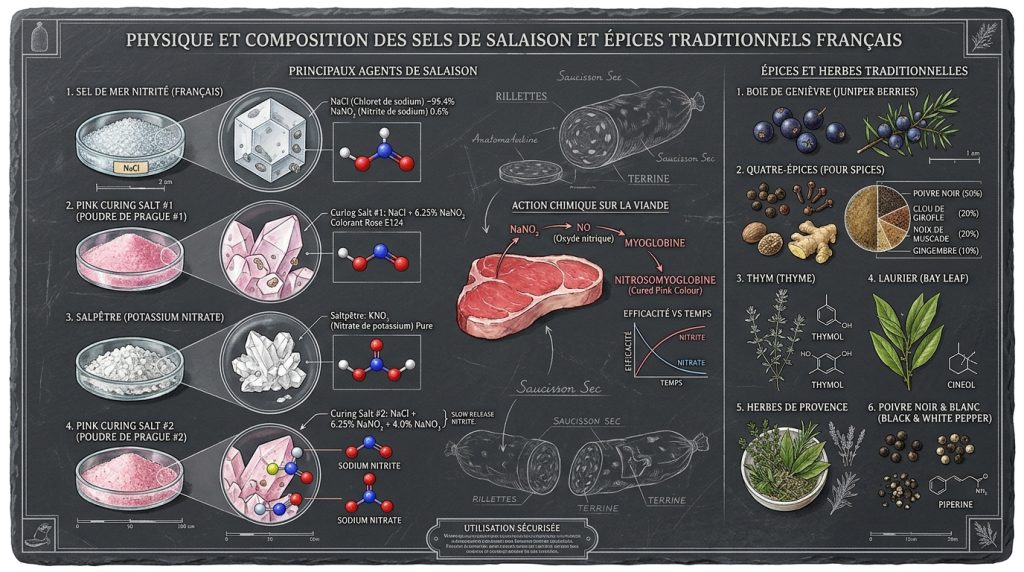
In addition to regular salt, many French charcuterie products use small amounts of curing salts — compounds containing nitrates or nitrites that play a specific role in food safety and appearance.
Nitrites and Nitrates : What They Do
- Prevent the growth of Clostridium botulinum the bacterium responsible for botulism, one of the most dangerous foodborne illnesses. This is the primary reason for their use.
- Fix the pink/red color of cured meats nitrites react with myoglobin in the meat to create a stable pink pigment. Without them, cured meats would turn an unappetizing grey-brown.
- Contribute to flavor development nitrites participate in complex chemical reactions during curing and aging that contribute to the characteristic ‘cured meat’ flavor.
Natural Alternatives
Many artisan French charcutiers particularly those producing under AOP or Label Rouge specifications — use naturally occurring nitrates from plant sources (celery powder, beetroot extract) instead of synthetic curing salts. The effect is identical, but the labelling can say ‘no added nitrites’. Some very traditional products, particularly very long-aged hams, rely on salt alone for preservation.
4. Spices and Aromatics : The Soul of the Recipe
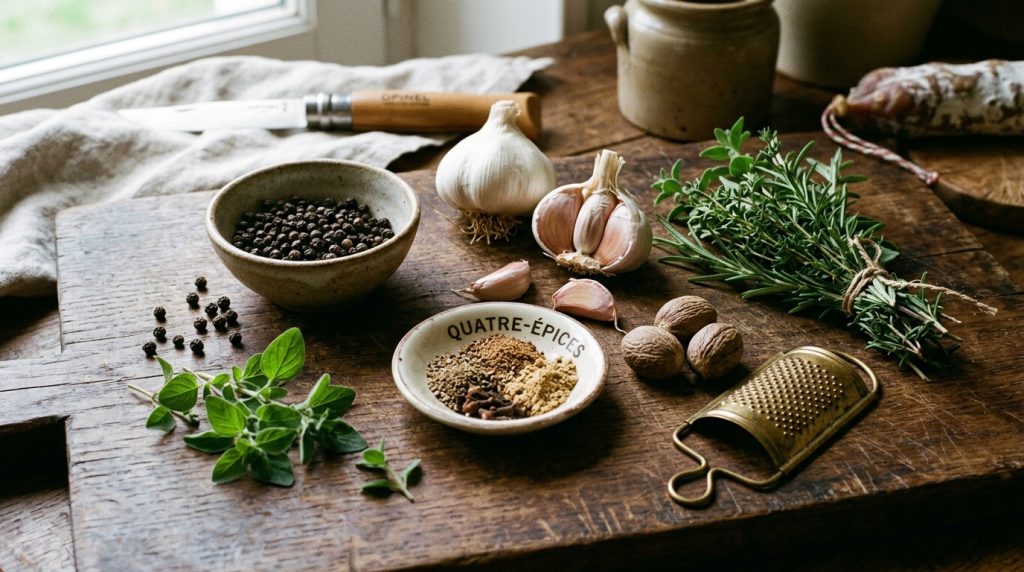
After salt, spices and aromatics are what give each French charcuterie product its distinctive character. The art of the charcutier lies largely in knowing which spices to use, in what proportions, and how they will develop during the curing and aging process.
Black Pepper : The Universal Constant
Black pepper is present in virtually every French charcuterie product saucisson, pâté, terrine, ham, rillettes. It is the one spice that transcends regional boundaries. Freshly ground black pepper contributes both heat and a complex aromatic profile that deepens beautifully during aging. Whole peppercorns are sometimes used in terrines and pâtés for visual appeal and bursts of flavor.
Garlic — The Regional Variable
Garlic is used extensively in the south of France particularly in saucissons from the Auvergne, Ardèche, and Provence but much more sparingly in the north and the Loire Valley. In the Loire, garlic is a background note in some rillettes but never dominant. In the south, it is front and centre. A Saucisson d’Auvergne without garlic would be unrecognisable.
Nutmeg :The Secret Ingredient
Nutmeg is one of the defining spices of French charcuterie used in small quantities in rillettes, pâtés, terrines, and white sausages. Its warm, slightly sweet, resinous character adds depth and complexity without announcing itself. A touch of nutmeg is what makes a good pâté de campagne taste unmistakably French.
Four-Spice (Quatre-Épices) : The Classic French Blend
Quatre-épices is a traditional French spice blend used extensively in charcuterie particularly in terrines, pâtés, and sausages. The classic combination is white pepper, nutmeg, cloves, and ginger (or cinnamon), ground together. It is the spice blend that defines the flavor profile of traditional French pâté de campagne and many regional terrines.
Herbes de Provence : The Southern Identity
Thyme, rosemary, savory, oregano, and bay leaf — the classic herbs of Provençal cuisine — appear in many southern French saucissons and terrines. They give the products a distinctly aromatic, Mediterranean character that contrasts with the more restrained spicing of northern and central French charcuterie.
Other Spices Used Regionally
- Piment d’Espelette the sweet, mildly spicy Basque chili pepper (AOP), used in Basque sausages and some Bayonne preparations. One of France’s most celebrated spice ingredients.
- Coriander seeds used in Alsatian charcuterie and some terrines, bringing a citrusy warmth.
- Juniper berries found in game terrines and Alsatian products, with a resinous, piney character.
- Caraway seeds a hallmark of Alsatian charcuterie, from the Germanic tradition.
- Cloves used sparingly in terrines and pâtés as part of the quatre-épices blend.
- Savory (sarriette) a herb central to the charcuterie of Provence and the southwest.
5. Wine and Spirits — Flavor and Preservation
The use of wine and spirits in French charcuterie is both practical and deeply cultural reflecting France’s unique position as the world’s greatest wine-producing nation.
Red and White Wine
Wine is used in saucissons, terrines, and pâtés across France always the local wine of the region. Beaujolais in the Lyon saucissons (Rosette, Jésus), Côtes du Rhône in Provençal products, Bordeaux in Périgord terrines. The wine contributes acidity (which aids preservation), tannins (which interact with the proteins), and a complex aromatic depth that simply cannot be replicated by any other ingredient.
White wine is used in rillettes particularly Rillettes du Poitou and in many terrines where a lighter, more delicate flavor is desired.
Cognac and Armagnac
A splash of Cognac or Armagnac in a terrine or pâté is one of the great secrets of French charcuterie. These aged grape spirits bring a warm, complex sweetness that elevates even a simple pâté de campagne to something exceptional. They also contribute alcohol, which helps preserve the product and sterilizes the surface of the meat.
Calvados
In Normandy, Calvados the region’s famous apple brandy takes the place of Cognac in local terrines and pâtés. Combined with Normandy pork and local apples, it creates a distinctly Norman flavor profile unlike anything produced elsewhere in France.
6. Sugar — The Overlooked Ingredient
Sugar’s role in French charcuterie surprises many people but it is a genuine and important ingredient, used in small quantities (typically 0.3 to 1% of the total weight) in many products.
What sugar does:
- Feeds the beneficial bacteria , the lactic acid bacteria that ferment the sugars during the étuvage phase, producing lactic acid that acidifies the product and creates an environment hostile to harmful bacteria.
- Balances the saltiness a small amount of sugar softens the perception of salt, making the final product taste more rounded and less harsh.
- Contributes to color development sugar participates in Maillard reactions during any heat processing, helping develop the characteristic color of cooked charcuterie products.
- Aids mold development , the slight sugar content helps feed the penicillium mold during the early stages of drying.
7. Fat — The Carrier of Flavor
Fat is not just an ingredient in French charcuterie it is the medium through which flavor is carried, developed, and expressed. The French charcuterie tradition has always understood that fat is not the enemy of flavor; it is its greatest ally.
Pork Back Fat (Gras dur)
The firm fat from the pig’s back is the most commonly used fat in French charcuterie. It is added to saucissons, terrines, and pâtés to achieve the right texture and fat content. Gras dur is firm enough to hold its shape when ground and mixed, producing visible fat particles in saucisson and rustic terrines.
Lard (Saindoux)
Rendered pork fat lard is used as a cooking medium for rillettes and confit, as a sealant to cover the surface of terrines and pâtés (preventing oxidation), and as a coating for some dry-cured products during aging.
Duck and Goose Fat
In southwest France, duck and goose fat replace pork fat as the primary cooking medium. Duck confit, duck rillettes, and foie gras are all cooked and preserved in their own fat one of the great flavor combinations in all of French cuisine.
8. Casings The Natural Container
Traditional French charcuterie uses natural casings the intestines, stomachs, and bladders of the pig — as containers for sausages and dry-cured products. Far from being a mere technicality, the choice of casing profoundly affects the final product.
- Small intestine (menu) used for standard saucisson sec and fresh sausages. Thin, permeable, allows moisture to escape evenly during drying.
- Large intestine (chaudin) — used for Jésus de Lyon. Thicker than small intestine, producing a larger, more irregular sausage.
- Caecum (fuseau) used for Rosette de Lyon. The large intestinal pouch that gives the Rosette its characteristic bulbous shape and forces a very long, slow drying.
- Pig’s bladder used for some very large specialty sausages. Extremely thick, produces the slowest drying of all.
- Stomach (panse) used for Andouille de Guémené and some pressed products.
- Beef middles larger diameter casings used for mortadella-style products and some large terrines.
9. Other Traditional Ingredients
Eggs
Eggs are used as a binding agent in terrines, pâtés en croûte, and galantines helping hold the mixture together and giving it a smoother, more cohesive texture when sliced.
Cream and Crème Fraîche
Used in refined terrines, mousse-style products, and fish rillettes. Cream enriches the texture and softens the flavor of lean meats like rabbit and veal, producing a more delicate, elegant result.
Gelatin and Aspic
Natural gelatin , produced by slow-cooking pork rinds, trotters, and bones, is used to make aspic, the clarified meat jelly used to fill the gaps in pâtés en croûte, coat pressed terrines, and preserve products like langue en gelée. Aspic is one of the great technical achievements of French charcuterie , beautiful to look at and intensely flavourful.
Pistachios and Truffles
In premium pâtés and terrines, pistachios and truffles (black or white) are used as luxury additions providing visual drama (the bright green of pistachios against the pale pink of the pâté), textural contrast, and in the case of truffles, an extraordinary aromatic depth. A good pâté de Périgord aux truffes is one of the great luxuries of French gastronomy.
Chestnuts
In Corsica and the Périgord, chestnuts appear in terrines and sausages — a reflection of the importance of the chestnut tree (called the ‘bread tree’ in Corsican tradition) in the regional food culture.
What You Will NOT Find in Traditional French Charcuterie
This is perhaps as important as what you will find. Traditional French charcuterie , particularly products carrying AOP, IGP, or Label Rouge certification explicitly prohibits certain ingredients that are common in industrial production:
- Artificial colorings , the pink color of cured meats comes from the natural reaction of nitrites with myoglobin, not from artificial dyes.
- Artificial flavors or flavor enhancers, the flavor of great charcuterie comes from the quality of the meat, the salt, and the time. Nothing else is needed or permitted.
- Fillers and extenders ,no soy protein, potato starch, or other fillers in certified traditional products.
- Excessive water , industrial products are often pumped with water to increase weight. Traditional charcuterie loses water during aging it does not gain it.
- Artificial preservatives , beyond permitted curing salts, no artificial preservatives are used in certified traditional French charcuterie.
This is why reading labels matters and why choosing certified products (AOP, IGP, Label Rouge) is the best guarantee that what you are eating is genuine, traditional French charcuterie.
Final Thoughts
What strikes me every time I think about the ingredients of French charcuterie is how few of them there are and how much the final product depends not on complexity of ingredients, but on quality, precision, and time. A great saucisson sec needs nothing more than excellent pork, the right salt, a little pepper, and months of patient drying. A great jambon needs only pork and salt.
Do not hesitate to experiment with combinations that appeal to you or to try improbable pairings. Sometimes the best surprises come from the most unexpected matches. That is precisely the pleasure of French charcuterie: the freedom to explore, guided by the experience and wisdom of an entire nation of food lovers who have been perfecting these combinations for centuries. Trust your instincts, trust your palate and enjoy the journey .