I have to be honest with you: when I first started exploring the world of French protected hams seriously, I thought I knew most of them. I was wrong. France has nine officially certified hams three AOP and six IGP and several of them remain almost completely unknown, even to many French people.
That is what I love about French charcuterie. No matter how deep you go, there is always something new to discover a forgotten mountain ham from the Ardennes, an extraordinary Corsican prisuttu made from free-ranging pigs in the maquis, a rare Basque breed that almost disappeared from the face of the earth.
In this guide, I take you through every single officially certified French ham verified against the INAO registry. No shortcuts, no approximations. Let’s go.
The AOP Hams : The Absolute Gold Standard
AOP Appellation d’Origine Protégée is the most demanding certification in European food law. Every single stage of production must happen within the defined geographical area. The pig must be born there, raised there, slaughtered there, cured there, and aged there. If even one step happens elsewhere, the product loses its right to the name. No exceptions.
France currently has three AOP-certified dry-cured hams. All three are extraordinary. All three deserve to be far better known internationally than they are.
🏔️ Jambon Noir de Bigorre AOP : The Rarest of the Rare
AOP since 2017 | Hautes-Pyrénées | Aging: 20 to 24 months minimum
If I had to choose one French ham to represent everything that is extraordinary about French charcuterie tradition, it would be this one. The Jambon Noir de Bigorre is produced from the Noir de Bigorre — a heritage breed of black pig that came within a whisker of extinction in the 1980s, when fewer than 30 breeding females remained. Today, around 3,000 animals exist. That is not many. Which is why you will rarely find this ham outside the Hautes-Pyrénées.
What makes it truly exceptional:
- The pigs roam free in the traditional Pyrenean mountain pastures called padouens feeding on acorns, chestnuts, roots and wild plants. This natural diet is the primary source of the ham’s extraordinary flavour.
- The salting uses rock salt from the salines of the Adour basin , not the same salt as Bayonne ham, a distinction that matters enormously to producers.
- Every single ham is individually identified and monitored by a Maître-Affineur, who performs regular olfactory soundings using a traditional horse-bone needle inserted into different parts of the ham to assess its internal aromatic development. I find this practice both ancient and deeply moving.
- The result: a ham of extraordinary complexity, dominated by dried fruit notes, with a fat so rich in mono-unsaturated fatty acids that it begins to melt at body temperature.
Do not buy it unless it bears the official AOP label. Without that label, it is simply not a genuine Jambon Noir de Bigorre regardless of what the packaging says.
Serve at 20-22°C. Slice paper-thin. Taste it alone first. Then pair with a dry Jurançon or a Pacherenc du Vic-Bilh from just across the valley.
🐷 Jambon du Kintoa AOP : The Basque Jewel
AOP since 2019 | Pyrénées-Atlantiques (Basque Country) | Aging: 16 to 18 months minimum
The Kintoa is the Basque Country’s answer to the Bigorre — and it is magnificent. Produced from the Pie Noir du Pays Basque, another rare heritage black pig breed, it takes its name from the ancient Basque territorial zone of Kintoa (or Pays-Quint), a medieval kingdom that straddled the French-Spanish border.
What I find particularly fascinating about the Kintoa is its production method — which is unmistakably influenced by its Iberian neighbours across the Pyrenees:
- The Pie Noir pig is born, raised, and slaughtered exclusively in the western Pyrénées-Atlantiques, in a mild, humid climate bathed by warm southern winds.
- The ham is cut in the traditional Iberian style — a long, elegant cut that preserves the entire leg with the trotter attached, giving it a minimum weight of 10kg.
- Salting uses the IGP Sel de Salies-de-Béarn the same legendary salt spring used for Jambon de Bayonne.
- The aging takes place in the natural séchoir of the Aldudes valley, ventilated by the alternating warm southern winds and cool Atlantic sea breezes a unique microclimate.
- Before packaging, the ham is rubbed with AOP Piment d’Espelette giving it a distinctive aromatic finish that is unmistakably Basque.
The Kintoa is still rare and difficult to find outside the Basque Country but that is part of its charm. If you find it, buy it. You will not regret it.
Pair with a dry Irouléguy blanc from the same valley, or a light Txakoli if you can find it.
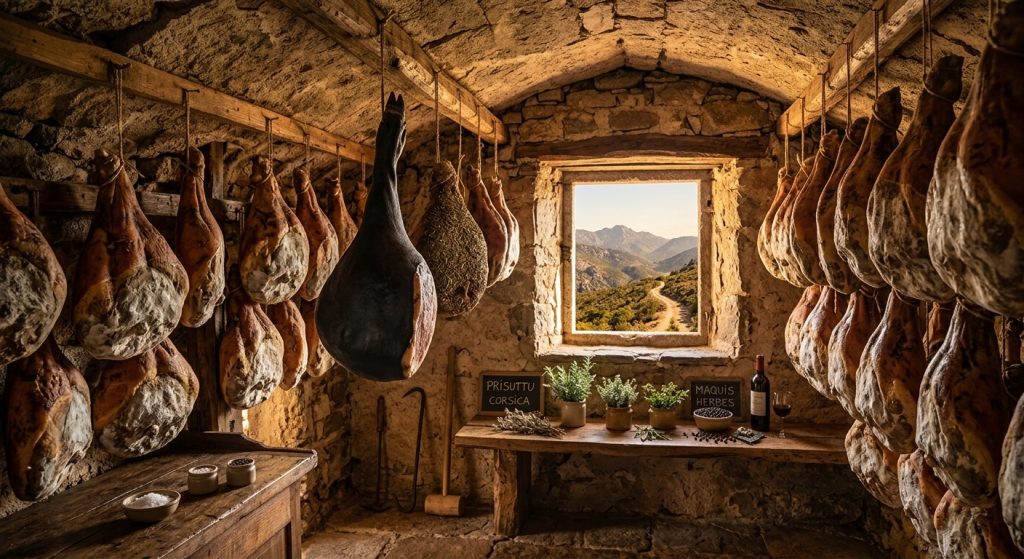
🏝️ Jambon sec de Corse Prisuttu AOP The Wild One
AOP since 2012 | Corsica | Aging: 12 months minimum
I confess: Corsican charcuterie was a revelation for me the first time I truly encountered it. There is something wild, untamed, and deeply aromatic about it that you simply do not find anywhere else in France and the Prisuttu, the Corsican dry-cured ham, is the finest expression of that wild character.
The Prisuttu is made from the Nustrale pig a semi-wild Corsican breed that roams free in the maquis, the dense aromatic scrubland of the Corsican interior, feeding on chestnuts, acorns, and wild roots. In Corsica, the chestnut tree was traditionally called the “bread tree” and its fruit remains central to the island’s food culture.
- The Nustrale pig lives semi-wild in the Corsican maquis the aromatic scrubland of heather, cistus, juniper, and wild herbs that gives Corsican charcuterie its unmistakable perfume.
- The ham is salted by hand with sea salt, then rubbed with wine and local aromatics before aging.
- Minimum 12 months aging though the finest Prisuttu are aged 18 to 24 months.
- The result: a ham with a deep, intense, slightly gamey character the herbs and aromatics of the maquis come through unmistakably in every slice.
- The fat is white and firm, with a slightly resinous, wild aroma that is unlike any other ham I have tasted.
Serve with Corsican brocciu cheese and a glass of Patrimonio rouge one of the great island wine appellations. Or simply alone, on a terrace overlooking the Mediterranean. That works too.
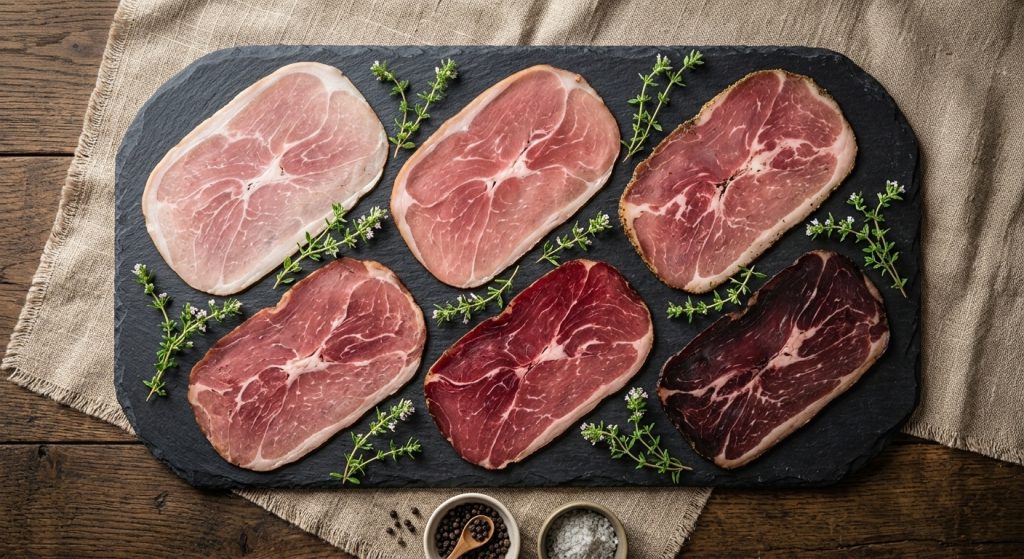
The IGP Hams — Six Strong Regional Identities
IGP Indication Géographique Protégée requires that at least one significant stage of production takes place in the defined geographical area. Less restrictive than AOP, but still a meaningful guarantee of regional origin and traditional method.
France has six IGP-certified dry-cured hams and I am delighted to say that two of them are considerably less famous than they deserve to be.
⭐ Jambon de Bayonne IGP The Ambassador
IGP since 1998 | Bassin de l’Adour | Aging: 7 months minimum
The Jambon de Bayonne needs little introduction — it is France’s most famous dry-cured ham and one of the most recognisable charcuterie products in the world. Named after the port city of Bayonne, through which these hams were historically exported across Europe, it is today produced across the much wider Adour basin in southwest France.
I have a particular affection for Jambon de Bayonne — not despite its accessibility, but because of it. This is the ham that introduced millions of people around the world to the idea that French cured ham could be something special. It is mild, delicate, slightly sweet, and remarkably low in salt — one of the least salty European hams, which surprises most people when they first taste it properly.
- Pigs born and raised across 22 departments of southwest France, fed on at least 60% cereals
- Salt: rock salt (sel gemme) from the Adour basin salines — a defining marker of this product’s identity
- Aging: minimum 7 months — premium versions aged 12 months or more develop considerably more complexity
- Flavour: mild, delicate, slightly sweet with a subtle nuttiness — approachable and endlessly versatile
My tip: do not settle for the cheapest version. A properly aged 12-month Jambon de Bayonne from a quality producer is a genuinely different experience from the mass-market 7-month version. Both are IGP certified but the difference in quality is significant.
🌋 Jambon d’Auvergne IGP The Mountain Warrior
IGP since 2016 | Cantal, Puy-de-Dôme, Haute-Loire, and parts of Allier and Corrèze | Aging: minimum several months
The Jambon d’Auvergne is one of my favourite discoveries in recent years a ham that carries centuries of mountain tradition and rewards those who seek it out with a bold, assertive character unlike anything from the lowlands.
Produced in the volcanic highlands of the Massif Central among the oldest geological formations in France it has been made by salaisonniers (salt-curers) in the mountain valleys of the Cantal, Puy-de-Dôme, and Haute-Loire for several centuries. The cool, dry mountain climate of the Auvergne is naturally ideal for slow drying, and the hams take on a firm, well-dried character that reflects their environment perfectly.
A fun historical footnote: Jambon d’Auvergne is immortalised in French popular culture it appears hanging from the ceiling of a tavern in the 11th Asterix album, ‘Le Bouclier Arverne’, published in 1968. Even the Romans knew about it, apparently.
- Region: the volcanic plateaux and mountain valleys of the Auvergne a cold, dry climate with strong seasonal winds ideal for natural drying
- Flavour: robust, assertive, and earthy the mountain terroir speaks loudly in every slice
- Texture: firm and well-dried, with a deep ruby-red colour
- Pair with: a glass of Saint-Pourçain rouge or a Côtes d’Auvergne the local wines are the natural companions
🌊 Jambon de Vendée IGP The Spiced Surprise
IGP | Vendée (Atlantic coast, western France)
The Jambon de Vendée is the most distinctive and perhaps the most surprising of all French IGP hams and the one that most consistently astonishes people who taste it without knowing what to expect.
Before drying, the ham is rubbed with a mixture of local sea salt, spices, and this is the detail that makes it unique a touch of local Vendée spirits or white wine. The result is a ham with a subtly sweet, gently aromatic quality that stands apart from every other French ham. It is not sweet in a cloying way it is sweet in the way that a perfectly ripe peach is sweet: natural, balanced, and deeply pleasant.
In April 2026, the Jambon de Vendée IGP was officially associated with the Label Rouge certification a recognition of its superior quality that I think is entirely deserved.
- Distinctive preparation: rubbed with local salt, spices, and sometimes a touch of Vendée spirits before drying , unique in France
- Flavour: subtly sweet, gently aromatic, with a softer, more approachable profile than mountain hams
- Traditional pairing: Mogette de Vendée IGP , the region’s celebrated white bean. A great regional combination.
- Pair with: a dry Fiefs Vendéens blanc , the local appellation, still little known but excellent
🏞️ Jambon de Lacaune IGP — The High Altitude Master
IGP since 2015 | Lacaune mountains, Tarn (southern France) | Aging: 9 months minimum
Lacaune is a small town at over 800 metres altitude in the Tarn mountains of southern France — and it has been one of France’s great charcuterie centres for centuries. The same mountain winds that make the climate ideal for drying also produce extraordinary sausages (the famous Saucisses de Lacaune IGP) and this excellent ham.
What I appreciate most about the Jambon de Lacaune is its description from the INAO itself: ‘souple, moelleuse et fondante , supple, mellow, and melting. For a mountain ham produced in such a rigorous environment, this tenderness is a remarkable achievement, and it speaks to the skill of the local salaisonniers.
- Region: 11 communes of the Lacaune and Murat-sur-Vèbre cantons in the Tarn a concentrated, specific terroir
- Texture: INAO describes it as ‘souple, moelleuse et fondante’ supple, mellow and melting. Not what you expect from a mountain ham.
- Flavour: light aromatic intensity with subtle hazelnut notes clean and precise
- Pair with: a Gaillac rouge from the same department, or a local artisan beer from the Tarn mountains
🌿 Jambon de l’Ardèche IGP — The Aromatic One
IGP | Ardèche (southeastern France)
The Ardèche is one of France’s most underrated departments — a wild, rugged, spectacularly beautiful territory of volcanic gorges, chestnut forests, and ancient villages clinging to rocky hillsides. Its charcuterie tradition is equally wild and underrated.
The Jambon de l’Ardèche is produced in the cool, dry mountain air of the Ardèche massif, traditionally seasoned with local herbs and sometimes a touch of red wine. The result is a ham with a distinctly aromatic, slightly rustic character , the herbs and wild plants of the Ardèche countryside come through in the flavour in a way that speaks directly of the landscape.
- Region: the mountain valleys of the Ardèche department, between the Massif Central and the Rhône Valley
- Flavour: distinctly aromatic, with herbal notes from local seasonings — more complex than you might expect
- Character: slightly rustic, honest, and deeply satisfying — a ham that makes no apologies for what it is
- Pair with: a Côtes du Vivarais rouge — the Ardèche’s own appellation, made from Grenache and Syrah
🌲 Jambon sec des Ardennes IGP — The Northern Outsider
IGP | Ardennes (northern France, Belgian border)
This is the one that always surprises people — including me, when I first learned about it. When you think of French dry-cured ham, you think of the south: the Pyrenees, the Auvergne, Corsica. You do not think of the cold, forested border region of the Ardennes, where France meets Belgium and Luxembourg.
And yet the Jambon sec des Ardennes has a long and proud tradition — one that reflects the Germanic and Belgian influences of this northern frontier region. Cold smoking is a key part of the production method, giving the ham a flavour profile that is quite unlike any other French ham: firmer, more intensely flavoured, with a distinct smoky depth.
It is produced in the dense beech and oak forests of the Ardennes — a landscape that has shaped the culture, the cooking, and the charcuterie of this region for centuries. The cold, humid forest climate is not the obvious environment for producing a great dry-cured ham. But the Ardennais have made it work — and the result is fascinating.
- Region: the Ardennes department in northern France, bordering Belgium and Luxembourg
- Production: cold smoking is a traditional part of the process — giving it a distinctive smoky character unlike any other French ham
- Flavour: firmer and more intensely flavoured than southern French hams, with a marked smoky depth
- Character: influenced by Germanic and Belgian charcuterie traditions — a genuine northern French identity
- Pair with: a Belgian Trappist beer or a dry Champagne — both produced nearby and both excellent companions
The Complete Picture All Nine French Protected Hams
Here, for the first time in English as far as I know, is the complete and verified list of every officially certified French dry-cured ham:
AOP (3):
- Jambon Noir de Bigorre AOP : Hautes-Pyrénées 20 to 24 months the rarest and most prestigious
- Jambon du Kintoa AOP : Pays Basque 16 to 18 months the Iberian-influenced Basque jewel
- Jambon sec de Corse / Prisuttu AOP Corsica 12 months minimum the wild Mediterranean outsider
IGP (6):
- Jambon de Bayonne IGP : Bassin de l’Adour 7 months minimum the world ambassador
- Jambon d’Auvergne IGP : Massif Central the bold mountain warrior
- Jambon de Vendée IGP : Atlantic coast the uniquely spiced surprise
- Jambon de Lacaune IGP :Tarn mountains the tender high-altitude master
- Jambon de l’Ardèche IGP : southeastern France the aromatic mountain ham
- Jambon sec des Ardennes IGP : northern France the smoky northern outsider
Pascal’s Guide: Which Ham Should You Try First?
- You want the ultimate French ham experience, money no object → Jambon Noir de Bigorre AOP. Full stop.
- You want something rare and exciting, with Basque character → Jambon du Kintoa AOP. Extraordinary.
- You want something wild, aromatic, and unlike anything else → Prisuttu de Corse AOP. The maquis in a slice.
- You want the classic, the benchmark, the reliable favourite → Jambon de Bayonne IGP. Always a good decision.
- You love bold, assertive mountain flavours → Jambon d’Auvergne IGP. Honest and deeply satisfying.
- You want something surprising and unique → Jambon de Vendée IGP. The spiced preparation will astonish you.
- You want to discover something almost nobody knows → Jambon sec des Ardennes IGP. The great unknown.
Frequently Asked Questions
What is the difference between AOP and IGP for French hams?
AOP requires that every single stage of production from the birth of the pig to the final aging of the ham — takes place within the defined geographical area. IGP requires that at least one significant stage of production occurs in the region. AOP is therefore a stronger guarantee of complete regional authenticity. Both are regulated by the INAO and legally recognised across the EU.
How can I recognise a genuine AOP or IGP certified ham?
Look for the official EU quality label logo on the packaging a red and yellow circular logo for AOP, or a blue and yellow logo for IGP. The certification name must also appear clearly. At a market or charcutier, ask directly any genuine producer will be proud to confirm their certification. If they hesitate or cannot show you the label, that tells you everything you need to know.
Are these hams available outside France?
Jambon de Bayonne IGP is widely available internationally. The others range from occasionally available (Jambon d’Auvergne, Jambon de Vendée, Jambon de Lacaune) to genuinely rare (Jambon Noir de Bigorre, Jambon du Kintoa, Prisuttu de Corse, Jambon de l’Ardèche, Jambon sec des Ardennes). For the rare ones, specialist French food importers in major cities are your best bet or plan a trip to France and seek them out at source.
Final Thoughts
Nine certified hams from the volcanic highlands of the Auvergne to the wild maquis of Corsica, from the Pyrenean mountain pastures to the beech forests of the Ardennes. Each one is a different story, a different landscape, a different tradition. Each one represents generations of knowledge, passion, and patient craft.
France is not just one country when it comes to charcuterie it is nine different worlds of ham, each with its own identity, its own character, and its own claim to your attention. My advice: explore them all. Start with what you can find, seek out what you cannot, and never stop being curious. The journey through French protected hams is one of the most rewarding in all of French gastronomy and I promise you, every discovery will be worth it.