Ask most people outside France what a pâté is, and they will tell you it is a smooth, spreadable paste usually something to do with liver, probably served at a dinner party, vaguely French. And they would not be entirely wrong. But they would be missing about 95% of the picture.
French pâté is one of the most diverse, sophisticated, and misunderstood categories in all of French charcuterie. It encompasses everything from the humble, rustic pâté de campagne that you find at every French market, to the extraordinary pâté en croûte a masterpiece of pastry, meat, and aspic that takes a skilled charcutier two days to produce. It includes game pâtés from the forests of the Sologne, liver mousses from Lyon, and the most controversial luxury food in France: foie gras.
In this introduction, I want to give you the foundations what pâté actually is, how it differs from terrine and rillettes, and what the main families of French pâté look like. Think of this as your map before the journey.
What Exactly is a Pâté?
The word pâté comes from the Old French word for pastry pâte. Originally, a pâté was simply a filling of seasoned meat baked inside a pastry crust. Over centuries, the term evolved to describe any preparation of ground or minced meat, mixed with fat, herbs, and spices, and cooked whether in pastry, in a terrine mold, or in other containers.
Today, the term pâté covers three distinct preparations:
- Pâté en croûte the original, baked inside a pastry shell. The most technically demanding and spectacular.
- Pâté en terrine baked in a ceramic or cast-iron mold (the terrine), then sliced and served cold. This is what most people mean when they say pâté today.
- Pâté de foie or mousse a smooth, emulsified preparation, often made with liver, cream, and butter. The most delicate and refined of the three.
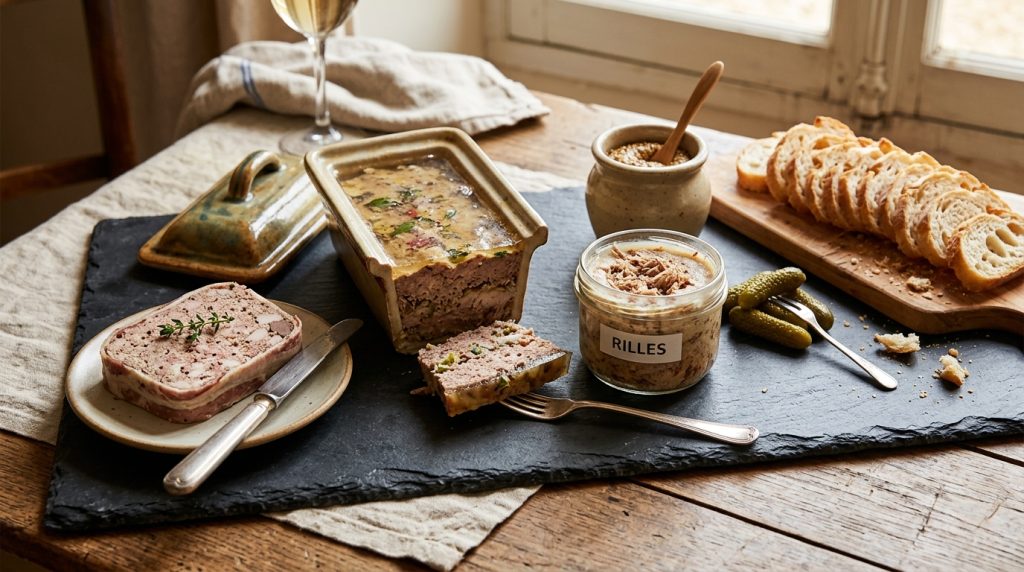
Pâté vs Terrine vs Rillettes The Essential Distinction
This is the question I am asked most often and it is a fair one, because the three terms are frequently confused, even in France.
Pâté
Made from ground or minced meat mixed with fat, eggs, and seasonings, then cooked in pastry (pâté en croûte) or in a mold (pâté en terrine). The texture is uniform and relatively smooth. The mixture is always raw when it goes into the mold and cooked through during baking.
Terrine
Technically, a terrine is simply a pâté cooked in a terrine mold the word terrine refers to the container as much as the product. However, terrines often have a coarser, more rustic texture than pâtés, sometimes incorporating whole pieces of meat, vegetables, or garnishes (pistachios, truffles, cornichons) for visual effect when sliced.
Rillettes
Rillettes are fundamentally different slow-cooked in fat, then shredded by hand. They are never ground, never emulsified, never baked. Always spreadable, always coarser than pâté, always rustic. If you have read my guide to French rillettes, you already know this distinction well.
The simplest summary: pâté is ground and baked; rillettes are cooked whole and shredded. Never confuse the two in front of a French charcutier — you will not hear the end of it.
The Main Families of French Pâté
French pâté is not a single product it is an entire universe. Here are the main families:
Pâté de Campagne :The People’s Pâté
The most democratic and beloved of all French pâtés. Made from coarsely ground pork, liver, herbs, and spices, it is the pâté you find at every French market, every charcutier, and on every traditional bistro menu. It is honest, generous, and deeply satisfying. It is also the gateway through which most people discover the world of French pâté and for good reason.
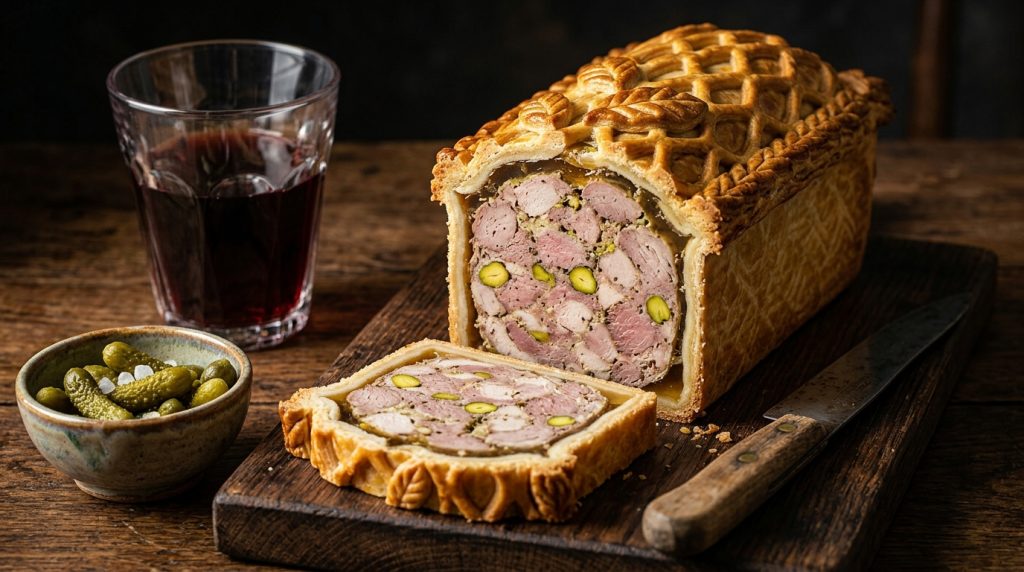
Pâté en Croûte :The Crown Jewel
The most technically demanding and spectacular pâté in French charcuterie. A carefully seasoned meat filling — often a combination of pork, veal, game, and luxury garnishes like truffles or pistachios — baked inside a precisely crafted pastry shell, then filled with clarified aspic through a small chimney hole. When sliced, the cross-section reveals a mosaic of colours and textures that is genuinely beautiful. Since 2009, there is an annual World Championship of Pâté en Croûte which tells you everything you need to know about how seriously the French take this product.
Pâté de Foie : From Everyday to Extraordinary
The family of liver pâtés ranges from the simple, everyday pâté de foie de porc pork liver pâté, smooth and mild to the extraordinary mousse de foie gras, made from the liver of force-fed ducks or geese. Between these two extremes lies an enormous range of products: chicken liver pâté, duck liver mousse, pâté de foie de volaille with Cognac. This family is perhaps the most misunderstood and the most rewarding to explore.
Pâté de Gibier :The Hunter’s Pâté
Game pâtés made from wild boar, venison, pheasant, rabbit, woodcock, or hare — are one of the great seasonal pleasures of French charcuterie. Produced primarily in autumn and winter, when hunting season is in full swing, they carry the wild, assertive flavours of the French countryside: the forests of the Sologne, the mountains of the Auvergne, the plains of the Beauce. These are pâtés with personality — sometimes challenging, always memorable.
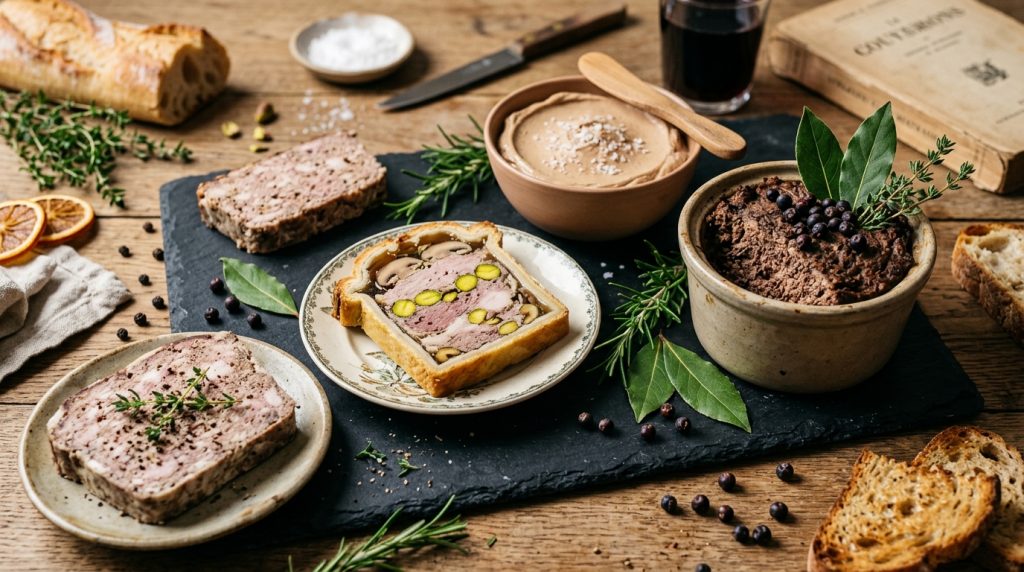
What Goes Into a French Pâté?
The basic structure of a French pâté consists of three elements:
- The farce the main meat mixture, ground or minced to the desired texture. This is the heart of the pâté.
- The garnish whole pieces of meat, vegetables, or other ingredients (pistachios, truffles, marinated strips of meat) embedded in the farce for visual and textural contrast.
- The liaison the binding element that holds the farce together. Usually eggs, sometimes cream or aspic.
The essential seasonings are: salt, black pepper, quatre-épices (the classic French spice blend of white pepper, nutmeg, cloves, and ginger), and usually a splash of Cognac, Armagnac, or white wine. The fat content is critical typically 30 to 40% of the total mixture as it provides moisture, richness, and the medium through which flavours develop during cooking.
How is a Pâté Cooked?
Most French pâtés are cooked au bain-marie in a water bath. The terrine or pastry shell is placed in a larger roasting pan filled with hot water, which surrounds the pâté with gentle, even heat and prevents the outside from overcooking before the centre is done.
The internal temperature is the critical measure: a pâté de campagne must reach 72°C at its core to be safely cooked through. Many experienced charcutiers will cook to 68-70°C for a slightly more moist and pink result a deliberate choice, not an accident.
After cooking, most pâtés are pressed under a weight while they cool this compacts the texture, removes air pockets, and helps the pâté hold its shape when sliced.
How to Eat a French Pâté
This seems like an obvious question , but there are a few rules that make all the difference:
- Always serve at room temperature pâté straight from the fridge is dense, cold, and muted in flavour. Take it out at least 20-30 minutes before serving.
- Slice generously a pâté slice should be at least 1cm thick. Thin slices crumble and lack presence on the plate.
- Always serve with cornichons the acidity of the small French pickles cuts through the richness of the pâté perfectly. This combination is non-negotiable in France.
- Add Dijon mustard on the side a small pot of strong Dijon mustard is the traditional companion.
- Choose the right bread a fresh baguette or toasted country bread. Never soft sandwich bread.
- Wine pairing , a light to medium red (Beaujolais, Chinon, Pinot Noir) for meat pâtés; a dry white (Vouvray, Alsace Riesling) for liver mousses and refined terrines.

Frequently Asked Questions
Is pâté the same as terrine?
Not exactly. A terrine is a type of pâté cooked in a terrine mold so all terrines are pâtés, but not all pâtés are terrines. Pâté en croûte, for example, is baked in pastry rather than a terrine. In common usage in France, the two terms are often used interchangeably for cold, sliceable preparations of ground meat.
How long does a pâté keep?
A homemade or artisan pâté, stored covered in the fridge, will keep for 4 to 7 days once cut. The fat layer on top of a terrine acts as a natural preservative keep it intact until you are ready to serve. Vacuum-sealed commercial pâtés have longer shelf lives, often several weeks.
Can pâté be frozen?
Yes most pâtés freeze well for up to 3 months. Defrost slowly in the fridge overnight. The texture may be slightly softer after freezing, but the flavour remains largely intact. Pâté en croûte does not freeze as well the pastry can become soggy.
Final Thoughts
French pâté is not a single thing it is an entire philosophy of cooking. It is the art of taking humble ingredients, treating them with respect and skill, and transforming them into something that is greater than the sum of its parts. It is the charcutier’s most direct expression of creativity , canvas of meat, fat, and seasoning on which centuries of French culinary tradition are painted.
In the articles that follow, I will take you deep into each family of French pâté from the honest pâté de campagne to the extraordinary pâté en croûte, from the silky liver mousse to the wild game pâtés of rural France. Welcome to one of the greatest chapters of French charcuterie.