If there is one product that embodies the soul of French charcuterie, it is the saucisson sec. Found on every French apéritif board, in every market, and in every French home, this humble dry-cured sausage is a national institution as French as the baguette or the Eiffel Tower.
Yet despite its simplicity, there is a world of complexity hidden inside that white-dusted casing. Different regions, different meats, different spices, different aging methods the saucisson sec is far more than just a sausage.
In this complete guide, Pascal takes you through everything you need to know about saucisson sec from its history and production to the best varieties and how to enjoy it like a true Frenchman.
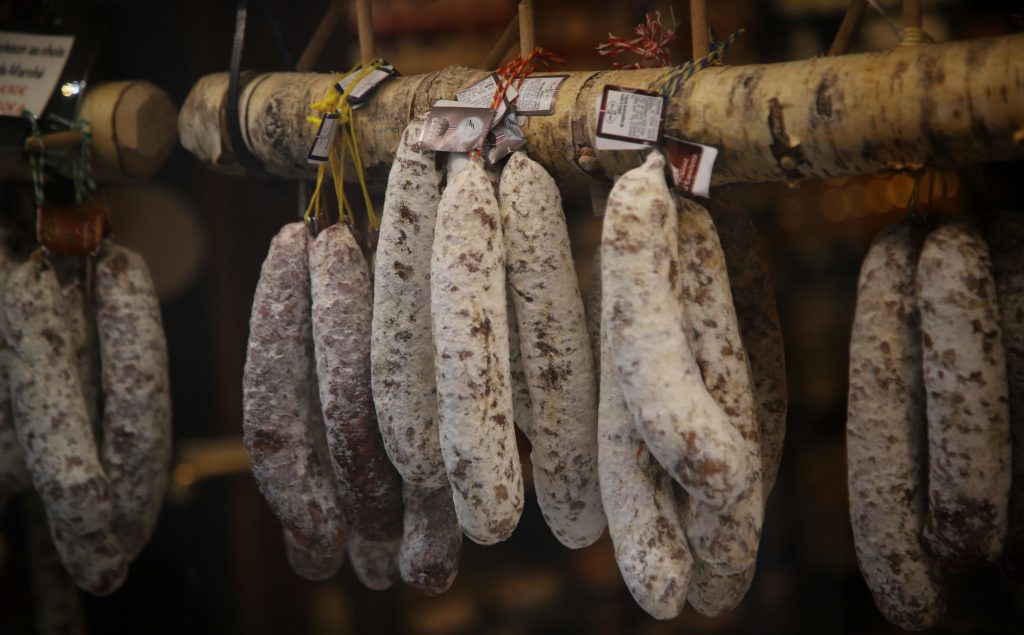
What is Saucisson Sec?
Saucisson sec (literally: ‘dry sausage’) is a traditional French cured sausage made primarily from pork, seasoned with salt, pepper, and various spices, stuffed into a natural casing, and left to dry-cure for several weeks.
Unlike cooked sausages, saucisson sec is never heated during production. Instead, it relies entirely on the curing process salt, time, and air to develop its firm texture, concentrated flavor, and long shelf life.
The white powdery coating on the outside is penicillium a natural, edible mold that develops during the drying process. Far from being a sign of spoilage, this mold bloom is actually a mark of quality, protecting the sausage and contributing to its complex flavor.
A Brief History of Saucisson Sec
The tradition of making dry-cured sausages in France dates back centuries. Before refrigeration, curing meat with salt and drying it in the open air was one of the primary methods of preservation allowing farmers and their families to store food through long winters.
Each French region developed its own recipe and technique, influenced by local climate, available spices, and the breed of pigs raised locally. Over time, these regional variations became cherished traditions some now protected by official French labels.
Today, France produces over 76,000 tonnes of saucisson per year making it one of the most consumed charcuterie products in the country, with each French person eating an average of 1.1 kg per year.
How is Saucisson Sec Made?
The production of a quality saucisson sec follows a precise process that has changed little over centuries:
1. The Meat Selection
Quality saucisson sec starts with quality pork. The best producers use a blend of lean pork meat (usually from the shoulder or leg) and pork fat (from the back fat or belly), ground coarsely to give the saucisson its characteristic rustic texture.
2. The Seasoning
The ground meat is mixed with salt (which draws out moisture and prevents bacterial growth), black pepper, and various other spices depending on the recipe garlic, red wine, herbes de Provence, or even Cognac in premium versions.
3. The Stuffing
The seasoned meat mixture is tightly packed into natural pork casings (intestines), which give the saucisson its characteristic shape. The ends are tied with string.
4. The Drying
The saucissons are hung in a cool, well-ventilated room (or a dedicated drying chamber) for a minimum of 4 weeks and up to several months for premium products. During this time, the saucisson loses 30-40% of its weight in moisture, the flavors concentrate, and the characteristic white mold bloom develops.
The Main Varieties of French Saucisson Sec
France produces dozens of regional varieties of saucisson sec. Here are the most important ones to know:
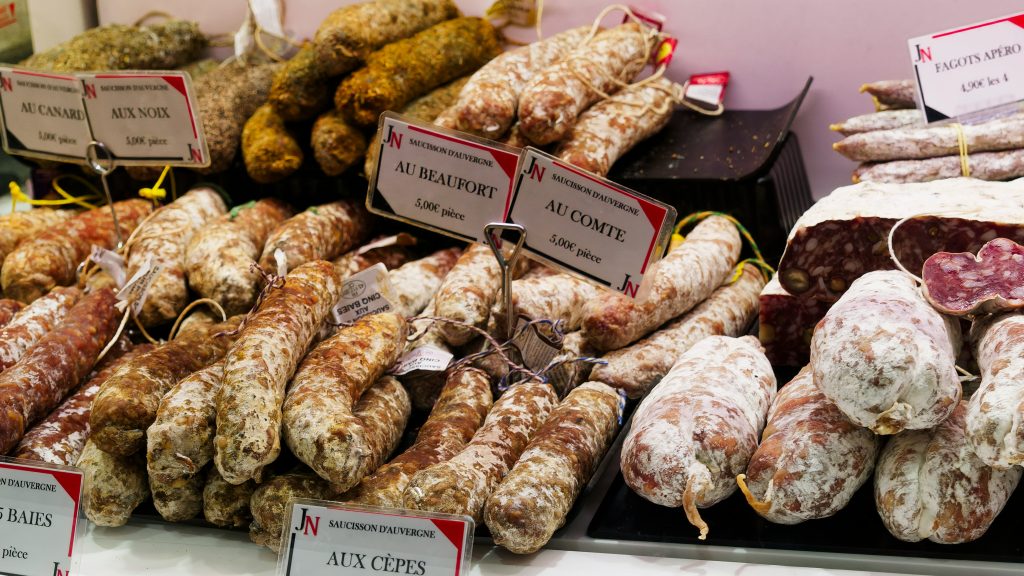
Saucisson d’Auvergne
From the volcanic highlands of the Auvergne region, this saucisson is known for its firm texture and slightly smoky, robust flavor. Made from pigs raised in the Auvergne mountains, it’s one of the most prized regional varieties.
Rosette de Lyon
The queen of Lyonnaise charcuterie. Larger than a standard saucisson, encased in the pig’s bladder and aged for several months. Finer texture, more delicate flavor, and a subtle wine-infused complexity.
Jésus de Lyon
A large, bulbous saucisson from Lyon — coarser and more intensely flavored than the Rosette. Its unusual shape (wider in the middle) comes from being stuffed into the pig’s large intestine.
Saucisson de l’Ardèche
From the rugged Ardèche region in southeast France, this variety is often made with a touch of red wine and dried herbs, giving it a distinctly aromatic, slightly rustic character.
Saucisson de Savoie
From the Alpine region of Savoie, this saucisson is often made with mountain-bred pigs and aged in cool mountain air. It has a clean, pure pork flavor with subtle herbal notes.
And these are just the beginning ! France is home to dozens more regional saucisson specialities waiting to be discovered from the Lonzu and Figatellu of Corsica, to the thin and elegant Fouet Catalan, the smoky Fuseau Lorrain, and the spiced Chorizo Basque.
Each French region has its own unique take on the dry sausage tradition. Stay tuned — we’ll be exploring them all
How to Eat Saucisson Sec Like a French Person
Preparation:
- Remove the casing: simply score the casing with a knife and peel it back as you slice. The white mold is edible but most people remove the casing.
- Slice it at room temperature: never slice cold saucisson straight from the fridge. Let it rest at room temperature for 15-20 minutes first.
- Slice it thick: unlike Italian salami, saucisson sec is traditionally sliced on the thicker side — about 3-4mm. This preserves its texture and full flavor.
What to serve with it:
- A fresh baguette — the classic pairing. Nothing more needed.
- Cornichons — the acidity balances the fat beautifully.
- Dijon mustard — a small pot on the side is perfect.
- A glass of red wine — Beaujolais, Chinon, or Côtes du Rhône are ideal matches.
- Butter — old-school French way: a thin spread of salted butter on the bread before laying the saucisson on top.
How to Store Saucisson Sec
One of the great advantages of saucisson sec is its long shelf life, thanks to the curing process:
- Whole, uncut saucisson: store in a cool, dry, well-ventilated place (a cellar or cool pantry is ideal). It will keep for several weeks to months.
- Once cut: wrap the cut end in wax paper or cling film and store in the fridge. Consume within 1-2 weeks.
- Never wrap in plastic entirely: the saucisson needs to breathe. Vacuum-sealing cuts whole ones is fine for transport, but open it as soon as possible.
- The white mold: if additional white mold develops on a stored saucisson, simply wipe it off with a clean cloth. It is harmless.
Where to Buy Quality Saucisson Sec
In France:
- A proper charcutier (specialist shop) — always the best option for handmade, artisan saucisson.
- French markets (marchés) — every town has a weekly market with charcuterie stalls.
- Supermarkets — decent quality, especially the ‘Rayon Charcuterie’ section with whole saucissons.
- Farm shops and regional producers — the ultimate source if you’re visiting the countryside.
Outside France:
- French delicatessens and specialty food stores.
- High-end supermarkets (Whole Foods, Waitrose, etc.) often carry imported French saucisson.
- Online specialty retailers — several shops now ship authentic French charcuterie worldwide.
- French farmers’ markets in major cities (New York, London, Sydney).
Frequently Asked Questions
Is the white coating on saucisson safe to eat?
Yes, absolutely. The white coating is penicillium — a natural, harmless mold that develops during the drying process. It’s edible, though most people prefer to peel the casing along with it. It has a mild, mushroomy flavor.
What is the difference between saucisson and salami?
Both are dry-cured pork sausages, but they have distinct differences. French saucisson sec tends to be coarser in texture, less spiced, and more purely ‘pork-forward’ in flavor. Italian salami is typically more finely ground, more heavily spiced (with garlic, fennel, or chili), and often more uniform in appearance. Both are delicious — just different.
Final Thoughts
Saucisson sec is more than just a snack — it’s a window into French culinary culture, regional identity, and the timeless art of transforming simple ingredients into something extraordinary through patience and skill.
Whether you’re enjoying it on a Paris terrace or recreating a French apéritif at home, a good saucisson sec , thick-sliced, room temperature, with a glass of Beaujolais and a crusty baguette , is one of life’s simple pleasures.
I am extremely inspired along with your writing skills as smartly as with the structure for your blog.
Is that this a paid theme or did you customize it
your self? Either way keep up the excellent quality writing, it’s uncommon to see a nice blog like this one
nowadays..
It’s actually a cool and useful piece of info. I’m happy that you simply shared
this helpful info with us. Please keep us informed like this.
Thanks for sharing.