If Jambon de Bayonne is France’s most popular dry-cured ham, then Jambon Noir de Bigorre is its best-kept secret and arguably its finest. Produced in tiny quantities from a near-extinct breed of black pig in the French Pyrenees, this extraordinary ham holds an AOP label and is considered by many connoisseurs to be among the greatest cured hams in the world the equal of the finest Spanish Jamón Ibérico de Bellota.
Yet outside of France and even within it very few people have heard of it. In this guide, I take you into the mountains of Bigorre to discover one of France’s most remarkable charcuterie treasures.
What is Jambon Noir de Bigorre?
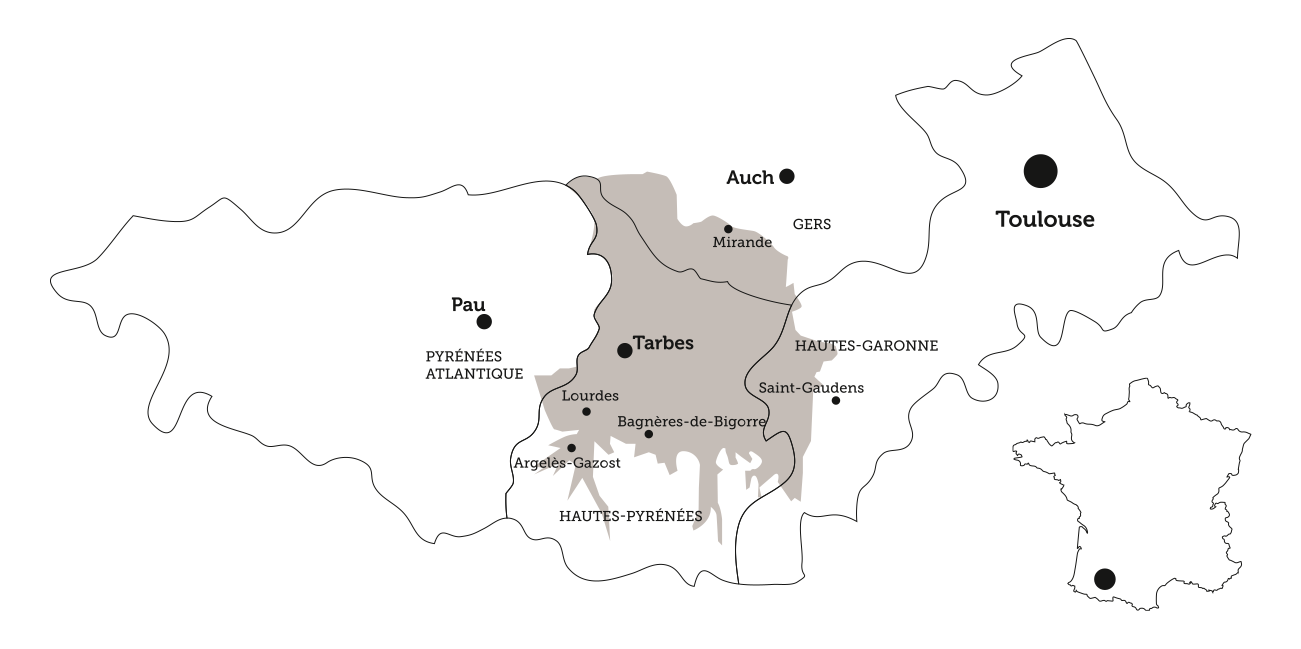
Jambon Noir de Bigorre (literally ‘Black Ham of Bigorre’) is a dry-cured ham produced exclusively from the Noir de Bigorre pig a heritage breed of black-coated pig native to the Bigorre region in the French Pyrenees (Hautes-Pyrénées department).
It holds an AOP (Appellation d’Origine Protégée) label the highest possible European guarantee of authentic origin and traditional production. Every element of its production, from the breed of pig to the mountain air used for drying, is strictly regulated.
Recognized as one of the finest hams in Europe, Jambon Noir de Bigorre sits alongside the greatest Iberian hams as an expression of what happens when an exceptional terroir, a unique animal, and generations of artisan knowledge come together.
The Noir de Bigorre Pig: A Breed Back from the Brink of Extinction
The story of Jambon Noir de Bigorre cannot be told without first telling the story of its pig because without the Noir de Bigorre breed, this ham simply cannot exist.
The Noir de Bigorre is one of France’s oldest pig breeds, with roots going back over 2,000 years in the Pyrenean foothills. For centuries, these black-coated pigs roamed freely in the mountain forests and meadows called padouens in the local dialect feeding acorns, chestnuts, roots, and wild plants.
By the late 20th century, the breed had been almost entirely replaced by faster-growing commercial breeds. By 1981, fewer than 30 breeding females remained — the Noir de Bigorre was on the verge of disappearing forever.
A small group of passionate farmers and breeders launched a rescue program in the 1980s, slowly rebuilding the population from those last surviving animals. Today, there are around 3,000 Noir de Bigorre pigs a remarkable comeback, but still tiny numbers that explain why the ham remains so rare and precious.
How the Noir de Bigorre Pig is Raised
The Noir de Bigorre pig lives a life that would make the most modern livestock envious. The strict AOP specifications require:
- Free-range living in the padouens the traditional Pyrenean mountain pastures. Pigs must have access to generous outdoor space, ensuring genuine free-range conditions year-round.
- Natural diet pigs feed primarily on what they find in the fields and forests: acorns, chestnuts, roots, grass, and wild plants. This natural diet is the primary source of the ham’s extraordinary flavor.
- Slow growth unlike commercial breeds that reach slaughter weight in 6 months, the Noir de Bigorre takes a minimum of 12 months often 18 to 24 months to reach maturity. This slow growth allows fat to develop deep within the muscle fibers, creating the characteristic of marbling that makes the ham so exceptional.
- Born and raised in Bigorre every pig must be born and raised within the defined geographical area of the Bigorre region in the Hautes-Pyrénées, at the foot of the French Pyrenees.
How Jambon Noir de Bigorre is Made
The production of Jambon Noir de Bigorre is one of the most demanding and time-consuming processes in all French charcuterie requiring specific expertise, great perseverance, and total dependence on the natural conditions of temperature and humidity of the Pyrenean foothills.
1. The Salting With Salt from the Adour Basin
The fresh hams undergo a gentle salting “salage doux” using rock salt sourced exclusively from the saline springs of the Adour basin a unique mineral-rich salt source at the foot of the Pyrenees that has been used for this purpose for centuries. This gentle salting process takes several weeks, with the salt being applied progressively to ensure even penetration without over-salting.
Note: this is an important distinction from Jambon de Bayonne, which uses salt from the Salies-de-Béarn springs. The Adour basin salt is specific to Bigorre production and contributes to the ham’s unique character.
2. The Long Affinage — 20 to 24 Months
After salting, the hams are aged in the open air for 20 to 24 months all within the same geographical area as the pig farming, at the foot of the French Pyrenees. This extended affinage in the natural mountain air is considered essential to the ham’s exceptional aromatic development.
To put this in perspective: a standard Jambon de Bayonne AOP is aged a minimum of 7 months. Jambon Noir de Bigorre is aged nearly three times as long minimum.
3. The Maître-Affineur Individual Attention for Every Ham
One of the most remarkable aspects of Jambon Noir de Bigorre production is that every single ham is individually identified and receives personalized attention throughout its entire aging process.
The Maître-Affineur (Master Curer) regularly performs olfactory soundings a traditional technique where a thin needle made of horse bone is inserted into different parts of the ham and then immediately smelled. This allows the expert to assess the internal aromatic development of each ham individually and make any necessary adjustments to the aging conditions.
This level of individual care and attention is extraordinarily rare in modern charcuterie production and is a key reason why Jambon Noir de Bigorre achieves such consistent excellence despite the natural variability of artisan production.
What Does Jambon Noir de Bigorre Taste Like?
This is a ham unlike any other French cured meat and the tasting experience fully reflects that. According to the producers themselves, here is what to expect:
- Color: the lean meat shows a beautiful range of colors from deep dark red to bright vermilion, passing through incarnate with orange tints. The fat is very white and silky, sometimes with delicate pink hues.
- Texture: sliced paper-thin and served at room temperature (ideally between 20°C and 22°C), Jambon Noir de Bigorre is soft, tender, and remarkably long on the palate.
- Flavor: a beautiful aromatic complexity dominated by dried fruit notes. The sublime aromas come primarily from the fat, which is exceptionally rich in mono-unsaturated fatty acids the same healthy fat profile found in olive oil.
- Fat quality: the exceptional fat of the Noir de Bigorre pig is almost liquid at room temperature, with a delicate, nutty, slightly sweet flavor that melts on the tongue.
- Finish: long, complex, and deeply satisfying with layers of flavor that continue to evolve after each bite.
Pascal’s note: Jambon Noir de Bigorre represents, through its very particular flavor, the most accomplished expression of a product that has connected, since time immemorial, a terroir, an animal, its way of life, and the expertise of the people who produce it. That is not marketing it is simply the truth.
How to Enjoy Jambon Noir de Bigorre
A ham of this quality deserves to be treated with respect. Here is how to get the most from every slice:
- Serve at the ideal temperature always between 20°C and 22°C (68-72°F). This is the temperature at which the fat softens to its perfect silky consistency and the aromas are fully expressed. Take the ham out at least 30-40 minutes before serving.
- Slice paper-thin ideally by a skilled ham carver using a long flexible knife. The thinner the slice, the more the flavor and texture reveal themselves.
- Taste it alone first before adding any accompaniment, taste a slice on its own. Let it melt on your tongue. This is a ham that speaks for itself.
- Simple accompaniments only fresh baguette, a little salted butter, perhaps a few cornichons. Nothing that would overpower the ham’s delicate complexity.
- Wine pairing a dry white wine from the Pyrenees (Jurançon sec or Pacherenc du Vic-Bilh) is the most authentic pairing. A light red Madiran also works beautifully.
Jambon Noir de Bigorre vs Jamón Ibérico: How Do They Compare?
The comparison with Spanish Jamón Ibérico de Bellota is inevitable — both are made from heritage black pig breeds, both are acorn-fed and long-aged, and both are recognized as among the finest cured hams in the world.
- Origin: Jamón Ibérico comes from the Iberian Peninsula (Spain/Portugal); Jambon Noir de Bigorre from the French Pyrenees.
- Breed: Ibérico uses the Iberian black pig; Bigorre uses the Noir de Bigorre black pig.
- Salt: Ibérico uses sea salt; Bigorre uses rock salt from the Adour basin salines.
- Aging: both are aged 20+ months minimum for quality versions.
- Fat profile: both are exceptionally rich in mono-unsaturated fatty acids — contributing to both their extraordinary flavor and their healthy nutritional profile.
- Flavor: Ibérico tends to be slightly more intense and savory; Bigorre is more subtle and complex with stronger terroir character.
- Availability: Jamón Ibérico is widely available internationally; Jambon Noir de Bigorre is extremely rare outside France.
- Price: both are premium products expect to pay €80-150+ per kg for top-quality versions of either.
Verdict: they are peers, not competitors. Both deserve their place among the world’s greatest cured hams.
Where to Buy Jambon Noir de Bigorre
Because production is so limited, Jambon Noir de Bigorre AOP is not easy to find but it is worth the effort.
- Directly from the producer: the official producer is Porc Noir de Bigorre, based in Louey (Hautes-Pyrénées). You can find their products and points of sale on porcnoir.fr.
- In the Pyrenees: the best place to experience it is directly in the Hautes-Pyrénées department farm shops, local markets, and specialty charcutiers in Tarbes and surrounding towns.
- In Paris: a few high-end charcutiers and food halls carry Jambon Noir de Bigorre AOP.
- Online: the official producer ships within France. Search for ‘Jambon Noir de Bigorre AOP’ to find authorized retailers.
- Outside France: extremely rare. Your best chance is through specialist French food importers in major cities.
Price guide: expect to pay between €80 and €150 per kilogram for a properly aged Jambon Noir de Bigorre AOP. A whole ham weighs between 7 and 9 kg. Vacuum-packed slices are available at a premium per gram.
You can also find authorized retailers on noirdebigorre.com.
Do not buy it unless it bears the official AOP label. You might find a very good dry-cured ham but without that label, it will not be a genuine Jambon Noir de Bigorre. The AOP is the only valid guarantee in the world that what you’re holding is the real thing.
Frequently Asked Questions
Is Jambon Noir de Bigorre the same as Jambon de Bayonne?
No they are very different products. Jambon de Bayonne is produced from standard commercial pig breeds and aged a minimum of 7 months using Salies-de-Béarn salt. Jambon Noir de Bigorre is produced exclusively from the rare Noir de Bigorre heritage breed, aged 20 to 24 months using rock salt from the Adour basin salines, and produced in tiny quantities with individual attention from a Maître-Affineur. They are in completely different categories in terms of breed, production, aging, flavor, and price.
Why is Jambon Noir de Bigorre so expensive?
Several factors combine to make it one of the most expensive hams in France: the rarity of the Noir de Bigorre breed (~3,000 animals), the very slow growth rate of the pigs (12-24 months to maturity), the 20 to 24 month aging period, the individual attention from a Maître-Affineur for every single ham, the tiny production volumes, and the strict AOP requirements. Each ham represents years of patient, artisan work from a unique, near-extinct animal.
What makes the fat of Noir de Bigorre so special?
The fat of the Noir de Bigorre pig is exceptionally rich in mono-unsaturated fatty acids — the same healthy fat profile found in olive oil. This gives the fat a silky texture, a low melting point (it begins to soften at body temperature), and a delicate, almost sweet flavor. This exceptional fat quality is directly linked to the pig’s slow growth, natural diet of acorns and chestnuts, and its genetic heritage and it is the primary source of the ham’s extraordinary aromatic complexity.
Final Thoughts
Jambon Noir de Bigorre AOP is more than just a ham it is the most accomplished expression of a relationship between a terroir, an animal, its way of life, and the expertise of the men and women who have preserved and perfected this tradition over centuries.
If you ever have the opportunity to taste a properly aged Jambon Noir de Bigorre served at 20-22°C, sliced paper-thin take it. You will understand immediately why those who know it consider it one of the great wonders of French gastronomy, and the equal of the finest hams in the world.