You’ve eaten saucisson sec dozens of times — that firm, flavourful French dry sausage with its characteristic white powdery coat. But have you ever wondered exactly how it gets that way? How does a simple mixture of pork and salt transform, over weeks or months, into one of France’s most beloved charcuterie products?
The answer lies in the art and science of dry-curing a process refined over centuries in the farms and cellars of rural France. In this guide, Pascal takes you step by step through the complete drying process, explaining not just what happens, but why.
Why Drying is the Heart of Saucisson Sec
The word ‘sec’ in saucisson sec simply means ‘dry’ in French and drying is indeed the defining characteristic of the product. Unlike cooked sausages, saucisson sec is never exposed to heat during production. Instead, it relies entirely on the controlled removal of moisture to:
- Preserve the meat by reducing the water activity that bacteria need to survive
- Concentrate the flavors as moisture leaves, the flavors intensify dramatically
- Develop the texture from soft and pliable to firm and sliceable
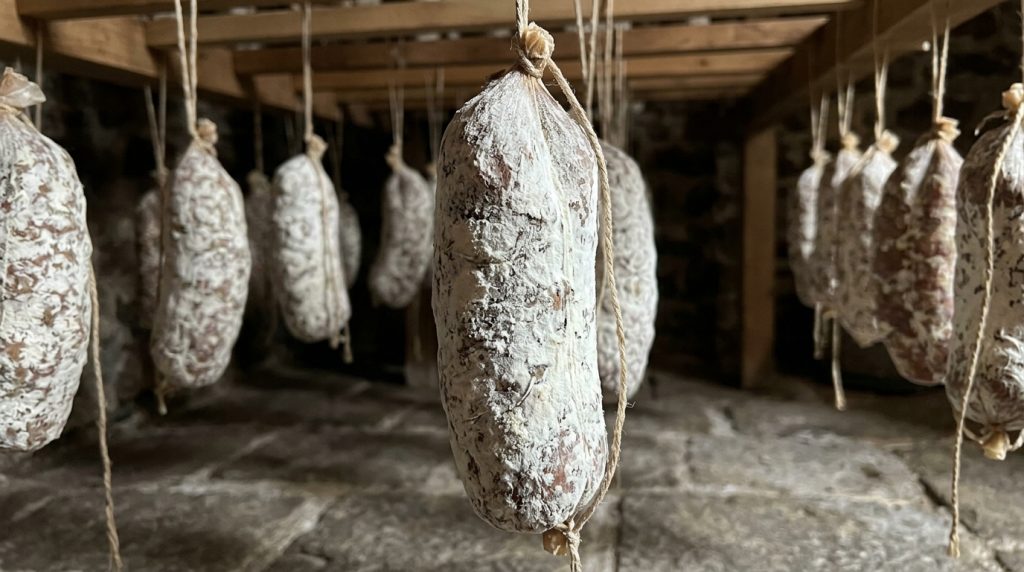
- Create the characteristic rind — including the iconic white mold bloom
A saucisson sec typically loses between 30% and 40% of its original weight during the drying process. That loss is almost entirely water which is why the flavors of a well-aged saucisson are so concentrated and intense compared to fresh sausage.
Before the Drying: Preparation and Salting
To understand the drying process, it helps to first understand what happens before the saucisson even enters the drying room.
The Meat Selection and Grinding
Quality saucisson sec begins with carefully selected pork typically a blend of lean shoulder or leg meat and back fat, ground coarsely to give the finished product its characteristic rustic texture. The fat content is crucial: too little and the saucisson will dry out and crack; too much and it will be greasy and unstable.
The ideal fat ratio for saucisson sec is typically between 25% and 35% enough to keep the product moist and flavourful throughout the long drying process.
The Curing Mix
The ground meat is mixed with a precise combination of:
- Salt the most important ingredient, typically 2.5% to 3% of the total weight. Salt draws out moisture, inhibits bacterial growth, and begins the curing process.
- Curing salts small amounts of nitrates or nitrites (or naturally occurring nitrates from ingredients like celery powder) are often added. These inhibit the growth of dangerous bacteria like Clostridium botulinum and help fix the saucisson’s characteristic rosy-pink color.
- Pepper the most common spice, adding heat and complexity.
- Sugar a small amount (typically 0.5-1%) provides food for the beneficial bacteria and molds that will develop during drying.
- Optional spices garlic, red wine, herbes de Provence, Cognac, or other regional additions depending on the recipe.
The Stuffing
The seasoned meat mixture is tightly packed into natural pork casings the small intestine for standard saucisson, the large intestine or bladder for larger varieties like Rosette de Lyon. The ends are tied with string, and the saucisson is pricked with a fine needle to allow any trapped air pockets to escape during drying.
The Drying Process: Stage by Stage
The drying of a saucisson sec is not a single event but a carefully managed progression through several distinct stages, each with its own purpose.
Stage 1 — The Étuvage (Warm Sweating Phase): Days 1-3
Immediately after stuffing, the saucissons undergo a brief warm phase called étuvage literally ‘steaming’ or ‘sweating’. The sausages are placed in a warm, humid environment (typically 20-24°C with 90-95% humidity) for 24 to 72 hours.
This phase serves several critical purposes:
- It activates the beneficial lactic acid bacteria naturally present in the meat, which begin fermenting the sugars and producing lactic acid slightly acidifying the saucisson and creating an environment hostile to harmful bacteria.
- The slight acidity helps set the protein structure of the meat, giving the saucisson its firm texture.
- The warmth and humidity encourage the surface of the casing to begin developing the conditions for mold growth in the next phase.
Stage 2 — The Mold Bloom: Days 3-10
This is one of the most fascinating and most misunderstood stages of saucisson production. As the saucissons move from the warm étuvage into the cooler, drier drying room, the white powdery coating that defines the appearance of saucisson sec begins to develop.
This white coating is penicillium a species of beneficial mold that grows naturally on the surface of the casing. It is the same family of mold used to make Camembert and Brie cheese rinds.
The penicillium mold performs several essential functions:
- It acts as a natural barrier, slowing the rate of moisture loss from the surface and ensuring the saucisson dries evenly from the inside out rather than forming a hard, cracked outer crust.
- It protects the surface from contamination by harmful molds and bacteria.
- It contributes to the flavor of the finished saucisson through enzymatic activity breaking down proteins and fats into flavor compounds that give well-aged saucisson its complex, slightly mushroomy depth.
- It regulates the humidity around the saucisson, creating a microclimate that favors controlled, even drying.
In artisan production, the penicillium mold develops naturally from spores present in the environment of the drying room accumulated over years or decades of production. In industrial settings, specific strains of penicillium are sprayed onto the surface of the saucisson to ensure consistency.
The Drying Room: Where the Magic Happens
The drying room called the séchoir in French is the heart of saucisson production. Getting the conditions right in the séchoir is the most critical skill of any charcutier.
Temperature
The ideal drying temperature for saucisson sec is between 12°C and 15°C (54-59°F) cool enough to prevent spoilage, warm enough to allow the slow enzymatic and microbial activity that develops flavor. Temperature fluctuations are carefully managed: too warm and harmful bacteria can multiply; too cold and drying stalls completely.
Humidity
Humidity is perhaps the most critical variable in the entire process. The ideal range is between 75% and 85% relative humidity. Too dry (below 70%) and the surface of the saucisson will form a hard, impermeable crust that traps moisture inside causing the interior to remain soft and potentially spoil. Too humid (above 90%) and drying stalls, creating conditions for harmful mold growth.
Air Circulation — The ‘Breath’ of the Drying Room
Air circulation is the third essential element and the one most intimately tied to French regional tradition. Gentle, consistent air movement is essential to carry moisture away from the surface of the saucisson and maintain even drying.
In traditional artisan production across France, natural ventilation plays a central role:
- In the Auvergne: the cool, dry mountain air of the Massif Central is considered essential to the character of Saucisson d’Auvergne. Traditional séchoirs have shuttered windows that are opened according to the weather and season.
- In Franche-Comté: the Saucisse de Morteau and Montbéliard are smoked in traditional tuyés large chimney rooms open to the sky where natural airflow from the mountains drives the smoking and initial drying.
- In the Pyrenees: the ‘souffle des Pyrénées’ the breath of the Pyrenees — is considered an essential ingredient in the production of Jambon de Bayonne and Pyrenean saucissons. Windows are opened in winter to let in the cold, dry mountain air.
- In Provence: the mistral wind, famous throughout southern France, naturally ventilates traditional drying rooms and is credited with giving Provençal charcuterie its distinctive dry, concentrated character.
How Long Does Drying Take?
The drying time for saucisson sec varies enormously depending on the size of the saucisson, the conditions of the drying room, and the desired final texture and flavor profile.
- Standard saucisson sec (small, ~200-300g): 4 to 6 weeks minimum. This produces a firm, well-dried saucisson with good flavor development.
- Medium saucisson (300-500g): 6 to 10 weeks. More complex flavor, firmer texture.
- Rosette de Lyon (large, 1-2kg): 3 to 6 months. The extended drying time allows the complex, wine-infused flavors to fully develop.
- Jésus de Lyon (very large, 2-4kg): 4 to 8 months. Deeply concentrated flavor and very firm texture.
- Premium aged saucissons: some artisan producers age their saucissons for 6 to 12 months, producing extraordinary flavor complexity.
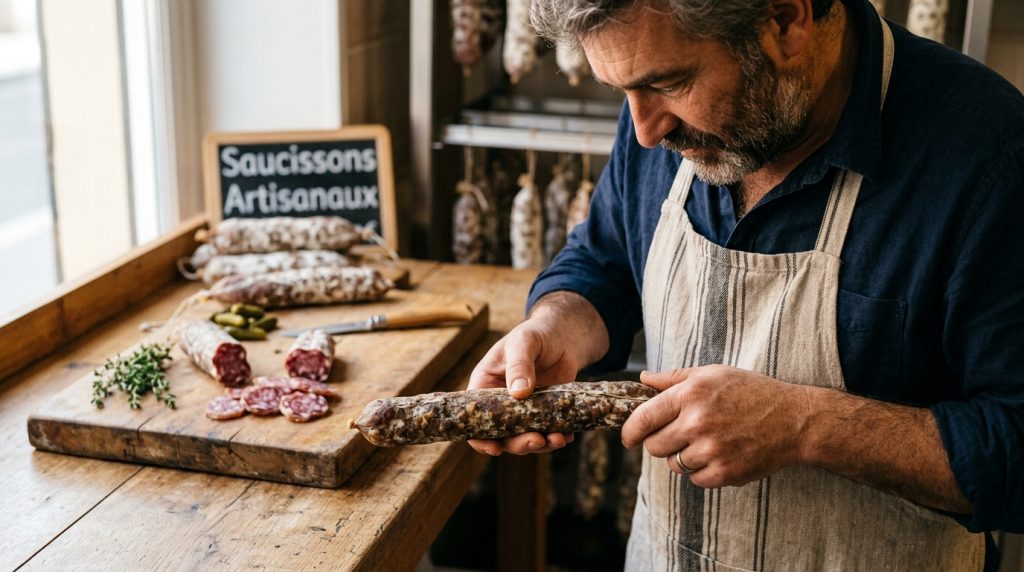
The traditional test for readiness: an experienced charcutier will press the saucisson gently with thumb and forefinger. The texture should be firm throughout with no soft spots — indicating that drying has been even and complete.
Natural Drying vs Industrial Drying: What’s the Difference?
The growing demand for saucisson sec has led to the development of industrial drying methods that can dramatically accelerate production — but at a cost.
Traditional natural drying:
- Uses natural air circulation from the environment
- Takes 4 weeks to several months
- Allows complex flavor development through slow enzymatic activity
- Produces a unique, terroir-driven product that reflects its environment
- Higher cost, lower volume — but superior quality
Industrial controlled drying:
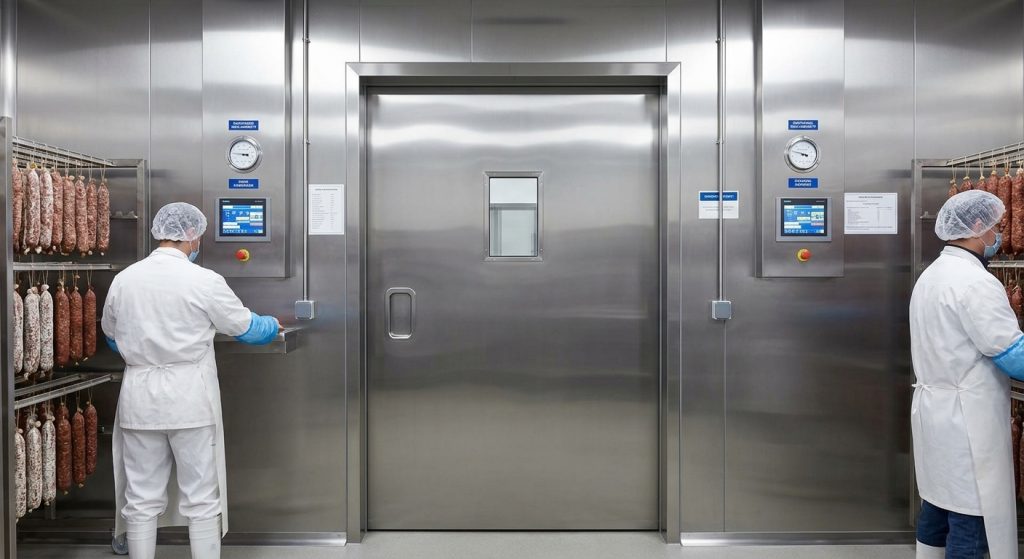
- Uses climate-controlled chambers with precise temperature, humidity, and airflow
- Can reduce drying time to as little as 2-3 weeks
- Produces consistent, predictable results but with less flavor complexity
- Lower cost, higher volume
- Often used for supermarket saucissons
This is why buying from a proper charcutier or looking for Label Rouge or IGP-certified products makes such a significant difference to what ends up on your plate. Look for products carrying an AOC, AOP, or IGP label for the best guarantee of traditional drying methods. For more on French quality labels, read our complete guide: French Food Labels Explained.
How to Tell if a Saucisson Sec is Well Dried
When buying saucisson sec, here are the signs of good, well-executed drying:
- Even white mold coverage — the penicillium bloom should cover the casing evenly. Bare patches suggest uneven drying or poor conditions.
- Firm but not rock-hard texture — a gentle squeeze should reveal firmness throughout with a slight give. Rock-hard texture may indicate over-drying or too-rapid drying.
- No cracks in the casing — cracks indicate the surface dried too quickly, creating a hard crust before the interior had time to dry properly.
- Clean, meaty aroma — a well-dried saucisson smells of cured pork, black pepper, and a subtle earthiness from the mold. Off smells (sour, ammonia-like, or putrid) indicate problems.
- Even color when sliced — the interior should show a consistent deep pink-red color with white fat distributed throughout. Grey or brown patches suggest oxidation or uneven drying.
Frequently Asked Questions
Is the white coating on saucisson sec safe?
Yes, completely safe. The white coating is penicillium — a beneficial mold that plays an essential role in the drying and flavor development of saucisson sec. It is edible, though most people prefer to remove the casing (along with the mold) before eating. It has a mild, slightly earthy, mushroomy flavor.
What if my saucisson develops green or black mold?
White or grey-white mold is normal and desirable. However, green, black, or strongly colored molds on the surface of a saucisson are a warning sign and should be treated with caution. A small amount of green mold on the surface can sometimes be wiped off with a cloth dampened in white wine or brine — but if the mold penetrates through the casing into the meat, discard the saucisson.
Can I dry saucisson sec at home?
Yes — home dry-curing of saucisson sec is entirely possible, but requires careful attention to food safety. The main challenge is maintaining the right temperature (12-15°C), humidity (75-85%), and air circulation consistently over several weeks. A dedicated mini-fridge with a temperature controller and a small fan is the most common home setup. We will be covering a complete home-curing guide in a future article on https://www.frenchcuredmeats.com
Final Thoughts
The drying of saucisson sec is a beautiful example of how patience, knowledge, and a deep understanding of the natural world can transform simple ingredients into something extraordinary. Every slice of a well-made saucisson sec represents weeks or months of careful monitoring, adjustment, and craft.
Next time you slice into a saucisson sec and admire its firm texture, its deep color, and its complex aroma take a moment to appreciate everything that went into creating it. It is, quite literally, the product of time itself.