I have been passionate about French charcuterie for over twenty years. I have visited hundreds of artisan butchers across every region of France, tasted thousands of products, and argued sometimes quite heatedly with fellow enthusiasts about what makes a truly great saucisson or a perfect andouille. But nothing, and I mean absolutely nothing, generates more passionate debate in French charcuterie circles than boudin.
Ask a Frenchman about boudin and watch his eyes light up or darken, depending on which camp he belongs to. “Boudin noir” or “boudin blanc”? Artisan or industrial? Regional recipe or the “authentic” version from his grandmother’s village? These are not casual questions. These are matters of identity, heritage, and deeply held conviction.
And yet, for anglophone food lovers, boudin remains one of the great mysteries of French gastronomy. “Is it blood sausage?” they ask. “Is it the same as black pudding?” The answer, as I will show you, is both yes and emphatically no. Boudin is something far more complex, more regional, more celebrated and frankly more extraordinary than most outsiders realize.
This is your complete guide to French boudin. By the end, you will understand why the French have created an entire knightly order devoted to it.
What Is Boudin? Cutting Through the Confusion
The word “boudin” comes from the Old French and likely traces back to the Latin “botellus,” meaning small sausage or intestine. But in modern French culinary vocabulary, boudin refers specifically to two very distinct products that share a name and a casing but little else in character:
Boudin Noir :the dark, blood-based sausage with deep, iron-rich flavors and a history stretching back to ancient times. This is what most people think of when they hear the word boudin in France.
Boudin Blanc : the pale, delicate sausage made from white meats, cream, and eggs. Traditionally a Christmas product, it is the refined, elegant cousin of boudin noir.
Beyond these two main categories, France produces a remarkable range of regional boudins from the spiced créole boudins of Martinique and Guadeloupe to the Réunionese versions fragrant with aromatics, from the thick, heavily seasoned boudins of Alsace to the delicate, truffle-studded versions of the Périgord. We are talking about dozens of distinct products, each with its own character, its own devoted following, and in many cases its own official recognition.
A History Written in Blood and Spice
Blood sausage is one of humanity’s oldest preserved foods. Archaeological evidence suggests that ancient Greeks and Romans produced versions of boudin noir, and the Roman writer Apicius recorded several blood sausage recipes. In France, the product evolved over centuries from a practical necessity using every part of the slaughtered pig into a genuine culinary art.
During the Middle Ages, charcutiers in French towns held the exclusive right to produce boudin noir, a privilege jealously protected by their guilds. The “fête du cochon” — the autumn pig slaughter was a community celebration in rural France, and boudin was always the first product made, while the pig’s blood was still fresh. Children would stand at the door of the farmhouse waiting for slices of freshly cooked boudin, which were eaten warm with applesauce or mustard.
This tradition of eating boudin noir immediately after slaughter “le boudin chaud” remains alive today in rural France. I experienced it myself years ago in the Perche region, and I can tell you there is nothing quite like freshly made boudin eaten within hours of production. It is a transformative experience.
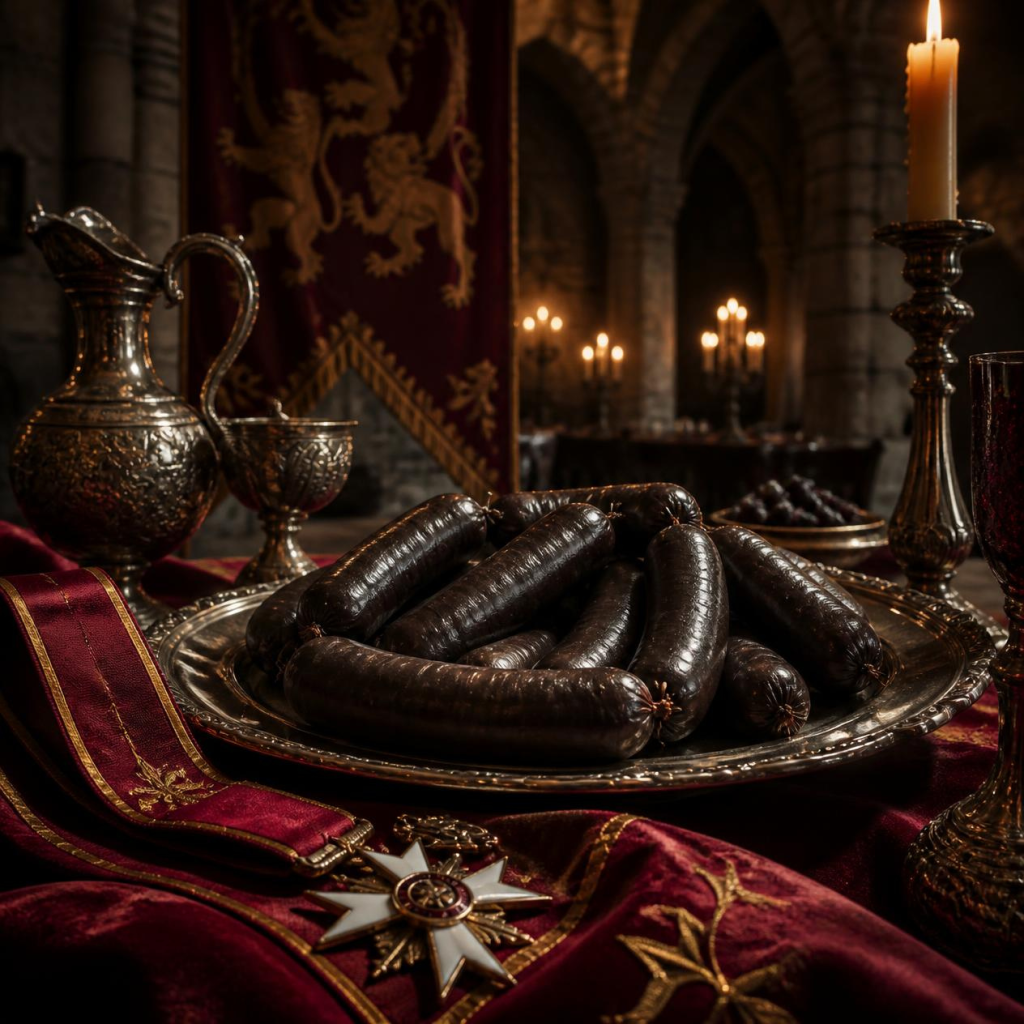
The Knights of the Boudin: La Confrérie des Chevaliers du Goûte-Boudin
This is where boudin truly distinguishes itself from virtually every other charcuterie product in France. In 1963, a group of passionate enthusiasts in Mortagne-au-Perche, a small town in the Orne department of Normandy, founded the Confrérie des Chevaliers du Goûte-Boudin : the Brotherhood of the Knights of the Boudin Tasters. Yes, you read that correctly. A knightly order devoted entirely to boudin.
The Confrérie awards several prestigious honorary titles, which are bestowed at the annual Foire au Boudin (Boudin Fair) in Mortagne-au-Perche:
🏆 Chevalier du Goûte-Boudin : The foundational knightly title, awarded to individuals who demonstrate exceptional knowledge of, and commitment to, French boudin culture.
🏆 Grand Maître : The highest honor within the Confrérie, awarded to those who have made extraordinary contributions to the preservation and promotion of boudin.
🏆 Compagnon du Boudin : A title awarded to international ambassadors and food journalists who have contributed to spreading the boudin gospel beyond France’s borders.
These are not merely ceremonial honors. The Confrérie maintains strict standards for what constitutes authentic boudin noir of quality, and its members are regular judges at national and international competitions. When the Confrérie speaks about boudin, the French charcuterie world listens.
La Foire au Boudin de Mortagne-au-Perche: The World’s Most Serious Sausage Competition
Every year on the third weekend of March, the small Norman town of Mortagne-au-Perche transforms into the boudin capital of the world. The Foire au Boudin has been held annually since 1963, attracting charcutiers from across France and increasingly from across the world. The numbers alone tell the story: in a single weekend, visitors consume around 5 tonnes of boudin noir that is 5,000 kilograms of blood sausage consumed in 48 hours in a town of fewer than 5,000 inhabitants.
The competitive element of the Foire is fierce. Entries are judged across multiple categories including:
Boudin Noir Traditionnel : Classic blood sausage judged on texture, seasoning, blood quality, and casing integrity
Boudin Noir avec Garniture : Blood sausage incorporating additional ingredients such as apples, onions, chestnuts, or spices
Boudin Blanc : White boudin judged separately for its delicacy and refinement
Boudin Exotique : A category that has increasingly recognized the remarkable boudins of France’s overseas territories
I have attended this fair multiple times, and I can tell you it is one of the most remarkable food events in France. The seriousness with which the judges approach their task sampling dozens of boudins, taking meticulous notes, debating texture and seasoning and appearance would not be out of place at a Michelin star restaurant evaluation.
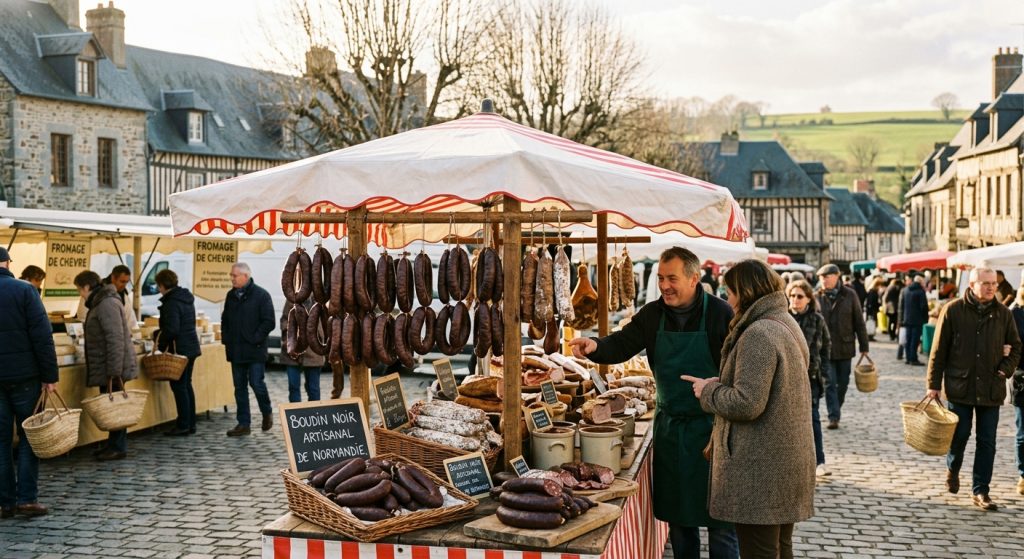
A Tour of French Regional Boudins
One of the great joys of studying French boudin is discovering how radically the product differs from one region to the next. France is not a monolith in its charcuterie traditions it is a mosaic of micro-traditions, each with jealously guarded secrets and fierce local pride.
Normandy and Perche: The Heartland
The Perche region, home of the Confrérie, produces what many consider the benchmark boudin noir. The recipe is deceptively simple: pig’s blood, onions, fat, cream, salt, pepper, and the four-spice blend (quatre épices) of pepper, clove, nutmeg, and ginger. The quality comes entirely from the freshness of the blood and the skill of the charcutier. Normandy’s boudin benefits from the region’s exceptional dairy products the cream added to many local recipes is incomparable.
Alsace: The Schwartzwurst Tradition
Alsatian boudin noir, influenced by German charcuterie traditions, is typically larger and more heavily seasoned than its western counterparts. The Alsatian tradition incorporates more pork fat and often includes groats or bread, giving the sausage a firmer, more substantial texture. The seasoning tends toward the boldly spiced, with generous use of marjoram and caraway alongside the traditional quatre épices.
Lyon: The Boudin Blanc Capital
Lyon’s claim to be the gastronomic capital of France extends to its extraordinary boudin blanc tradition. Lyonnaise boudin blanc is made with pork, chicken, or veal sometimes a blend combined with cream, eggs, and a delicate seasoning. The texture is notably smooth and unctuous, the flavor refined and subtle. At Christmas, every butcher in the city displays towers of these pale, elegant sausages. For serious boudin blanc, there is no better city in the world.
Brittany: Cider and Spice
Breton boudin has its own distinctive character, often incorporating local cider in the preparation of the onions, which are gently cooked down in cidre bouché before being incorporated into the sausage. Some Breton charcutiers add buckwheat flour, giving their boudin a slight nuttiness that complements the earthy blood perfectly. Eaten with Breton galettes and a glass of local cider, it is one of the most satisfying food combinations I know.
Beyond Metropolitan France: The Extraordinary Boudins of the DOM-TOM
This is where boudin truly becomes something extraordinary, something that most French food guides utterly fail to cover. When we talk about French boudin, we must talk about the overseas departments and territories — the DOM-TOM — because the boudins produced there are, in my view, some of the most exciting and complex versions of this product anywhere in the world.
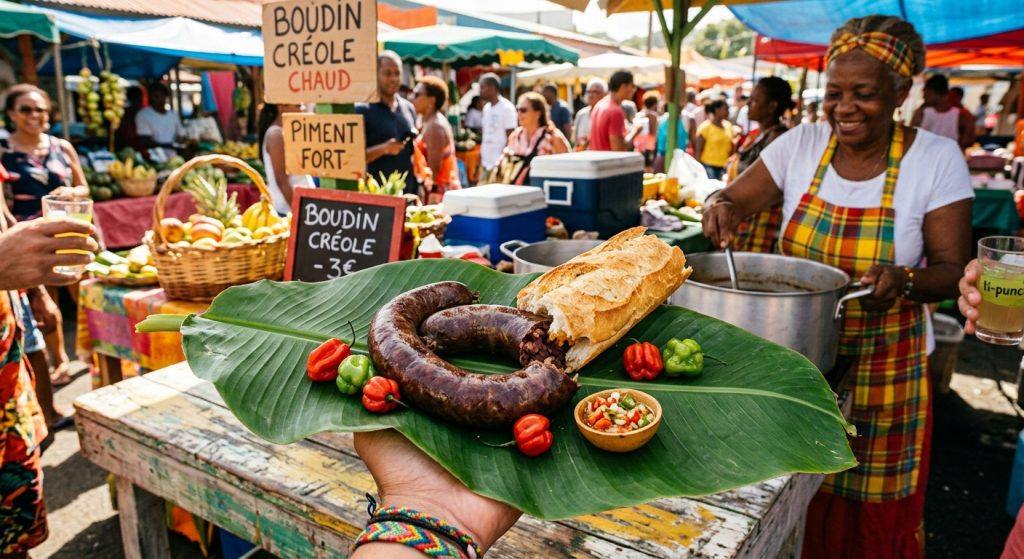
Martinique and Guadeloupe: Boudin Créole
The boudin antillais of Martinique and Guadeloupe is a revelation. Made with pig’s blood, aromatics, and a blend of Caribbean spices hot peppers ,particularly bois-bossé and piment végétarien, chives , parsley, garlic, thyme, allspice , and cloves this boudin has an intensity and aromatic complexity that Metropolitan French boudin cannot match.
The key difference from French boudin noir is the Scotch bonnet or habanero pepper that gives boudin créole its characteristic heat. This is not a polite heat it is genuine, building warmth that makes the rich blood sausage flavors sing. In Martinique, boudin is eaten as street food, served warm from a vendor’s cart with a piece of baguette. In Fort-de-France, you can find boudin at every market, every fête, every family gathering.
The Guadeloupean version differs subtly from the Martiniquaise a little more pepper here, a different blend of aromatics there. Each island’s charcutiers insist their version is the definitive one. Having tasted both extensively, I refuse to choose a winner.
La Réunion: Boudin with Indian Ocean Complexity
Réunionese boudin reflects the island’s extraordinary multicultural heritage French, African, Indian, Chinese, and Malagasy influences all contribute to the local charcuterie tradition. The boudin réunionnais typically incorporates curry leaves, turmeric, and ginger alongside the more traditional French aromatics, giving it a complexity that is utterly unlike anything produced in Metropolitan France.
Some Réunionese boudins incorporate rougail the local tomato-based condiment directly into the filling, creating a product that bridges the gap between sausage and curry in the most delicious possible way. I first encountered this version at a Sunday market in Saint-Paul, and it genuinely changed how I think about the potential of blood sausage.
How to Buy, Store, and Cook Boudin
For anglophone visitors to France or for those lucky enough to find French boudin outside of France here is my practical advice:
Buying Boudin
Always buy from a charcutier rather than a supermarket when possible. Ask when the boudin was made fresh boudin, made that day or the previous day, is incomparably better than week-old product. Good boudin noir should have a deep, dark color that is almost black when raw, with no gray patches (a sign of age or poor blood quality). The casing should be intact and slightly taut.
Cooking Boudin Noir
The classic French preparation is deceptively simple: cook in a dry frying pan over medium heat, turning gently to avoid splitting the casing. The boudin is ready when the exterior is slightly caramelized and the interior is just heated through approximately 8 to 10 minutes for a standard-sized piece. Serve immediately with roasted apples ,cooked in butter with a pinch of sugar, mashed potato, or simply a green salad and good mustard.
The apple accompaniment is not merely traditional it is genuinely inspired. The sweetness and acidity of good cooking apples such as Reinette or Boskoop cut through the rich, iron-heavy flavor of the blood sausage with brilliant effect. This is one of those perfect culinary pairings that rewards contemplation.
Final Thoughts: Why Boudin Deserves Your Attention
Boudin is perhaps the most honest product in all of French charcuterie. It cannot be faked, cannot be disguised with excessive seasoning or artificial flavors. Good boudin is good because of the quality of the pig, the freshness of the blood, the skill of the artisan, and the integrity of the recipe. There is nowhere to hide.
The fact that the French have created a knightly order to celebrate it, hold an annual festival that draws tens of thousands of visitors, and argue with genuine passion about regional variations tells you everything you need to know about how seriously this product is taken.
In the two articles that follow in this series, I will dive deeper into boudin noir and boudin blanc separately their history, their regional variations, their competitions, and their preparation. For now, I encourage you simply to seek out the best boudin you can find, cook it well, and give it the attention it deserves.