If there is one preparation in all of French charcuterie that stops people in their tracks, it is the pâté en croûte. A perfectly baked pastry shell encasing a mosaic of seasoned forcemeat, tender fillings, and jewel-bright aspic sliced to reveal an almost impossibly beautiful cross-section , the pâté en croûte is at once a feat of craftsmanship, a work of edible art, and one of the most satisfying things you will ever eat.
It is also, for many people outside France, something of a mystery. This guide will change that.
What is Pâté en Croûte?
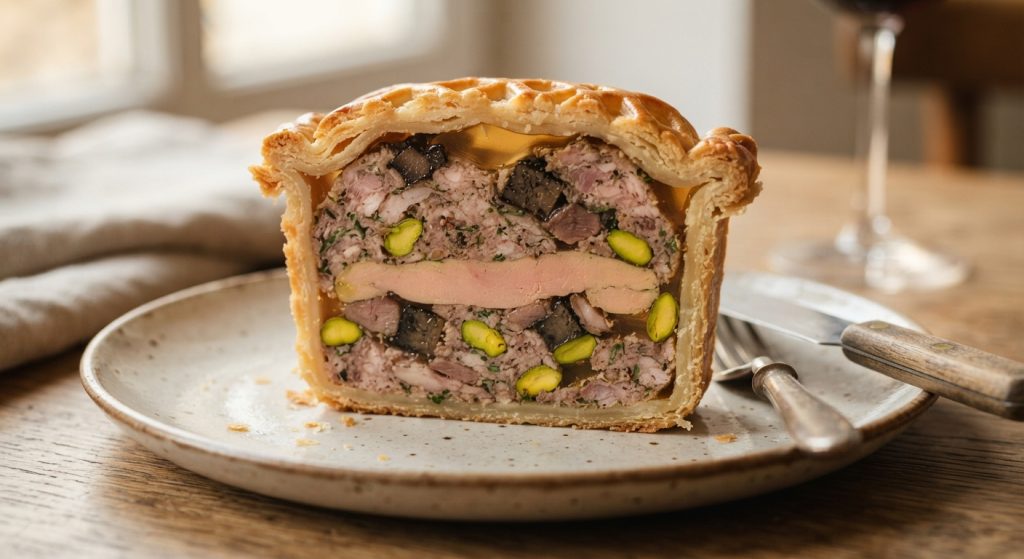
Pâté en croûte literally “pâté in a crust” is a preparation in which a seasoned meat filling (the farce or forcemeat) is enclosed in a sturdy pastry shell, baked in a hinged mold, and then filled with a savory aspic that sets as it cools. The result is sliced to reveal the interior: a decorative cross-section of meat, fat, garnishes and aspic that varies from artisan to artisan.
It is one of the oldest preparations in the French charcuterie tradition, with written recipes dating back to the 14th century. For centuries it was the showpiece of the charcutier’s craft the preparation that demonstrated his mastery of pastry, seasoning, texture, and presentation simultaneously.
Today, pâté en croûte is undergoing a remarkable revival. Once considered old-fashioned, it is now celebrated in competitions, championed by a new generation of charcutiers, and appearing on the menus of some of the finest restaurants in France.
The Anatomy of a Pâté en Croûte
Understanding what goes into a pâté en croûte helps you appreciate what you are eating and what you are looking at when you see one in a charcuterie window.
The Pastry “La Pâte”
The shell of a pâté en croûte is made from a special pastry called pâte à pâté a firm, sturdy dough designed to hold its shape during baking, support the weight of the filling, and slice cleanly without crumbling. It is made with flour, butter or lard, eggs, salt, and sometimes a little water.
The pastry must be firm enough to act as a mold, but not so thick or dense that it overwhelms the filling. Getting this balance right is one of the fundamental skills of the craft.
The Forcemeat “La Farce”
The heart of the pâté en croûte is the forcemeat a finely seasoned mixture of ground or chopped meat, fat, eggs, and aromatics that provides the base flavor and binds the filling together. Traditional forcemeats use pork (often a combination of lean meat and back fat), but modern versions may include veal, poultry, game, or even seafood.
The seasoning of the forcemeat is critical. Classic spice blends include quatre-épices (four spices: pepper, cloves, nutmeg, ginger), salt, and often a splash of cognac, port, or Madeira.
The Garnish “La Garniture”
What makes a “pâté en croûte” visually spectacular is the garnish embedded within the forcemeat the elements that create the decorative pattern when the pâté is sliced. These might include:
- Strips of duck breast, chicken liver, or foie gras
- Whole pistachios or hazelnuts
- Strips of ham, tongue, or truffle
- Dried fruits such as apricots or prunes
- Thin slices of pork back fat
The arrangement of these elements within the mold and the pattern they create when sliced is where the charcutier’s artistry is most visible.
The Aspic “La Gelée”
After baking, as the pâté cools and shrinks slightly away from the pastry walls, a gap forms between the filling and the crust. This is filled with a liquid aspic a clarified, intensely flavored stock set with gelatin , that is poured through a small hole in the pastry lid and then allowed to set.
The aspic serves multiple purposes: it fills the gap, keeps the filling moist, adds flavor, and when set and sliced, creates the characteristic jewel-like appearance that makes “pâté en croûte” so visually distinctive.
How Pâté en Croûte is Made: The Process
Making a “pâté en croûte” is a multi-day, multi-stage process that requires patience, precision, and skill. Here is an overview of the main steps:
Day 1 : Preparation: The forcemeat is prepared and seasoned. Many charcutiers allow the seasoned meat to rest overnight in the refrigerator to allow the flavors to develop and meld this step is called the marinade.
Day 2 : Assembly: The pastry is made and rested. The mold is lined with pastry, filled with alternating layers of forcemeat and garnish, sealed with a pastry lid, and decorated. Small holes “cheminées” “are made in the lid to allow steam to escape during baking and aspic to be added afterward.
Baking: The assembled pâté is baked in the oven typically at around 170-180°C until the internal temperature of the filling reaches a food-safe level (usually around 65-70°C at the center). The pastry should be golden brown and the filling fully cooked.
Cooling and Aspic: Once baked, the pâté must cool completely often overnight before the aspic is added. The liquid aspic is poured through the cheminées, filling the gap between filling and crust, and the pâté is refrigerated until the aspic is fully set.
Slicing: Only after the aspic has completely set can the pâté en croûte be unmolded and sliced. The first slice reveals the cross-section the moment of truth for the charcutier.
Regional Variations
Like most great French charcuterie traditions, pâté en croûte takes different forms in different regions.
Pâté en Croûte de Volaille (Poultry): Chicken or duck-based forcemeat with garnishes of duck breast strips, foie gras, and pistachios. Particularly associated with the Lyon region.
Pâté en Croûte de Gibier (Game): Wild boar, venison, or pheasant-based, with bold, earthy seasoning. Traditional in Alsace and the Ardennes.
Pâté en Croûte de Veau et Jambon (Veal and Ham): A lighter, more delicate version with a forcemeat of veal and pork, garnished with strips of quality ham. Found throughout France.
Pâté en Croûte Périgourdin: From the Périgord region — naturally featuring foie gras and truffle among the garnishes, making it one of the most luxurious versions.
The World Championship of “Pâté en Croûte”
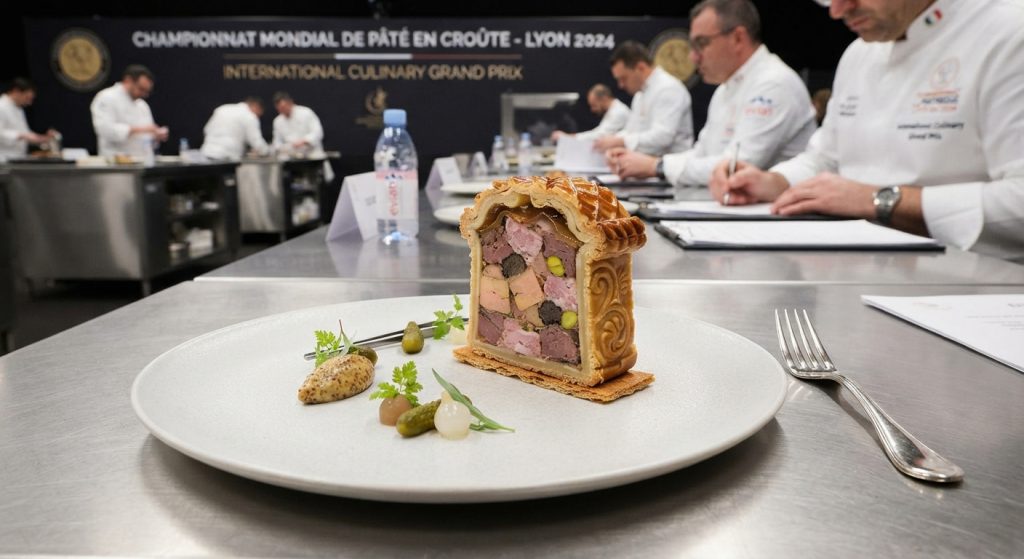
Such is the renewed prestige of this preparation that since 2009, there has been an annual “Championnat du Monde de Pâté-Croûte” a world championship dedicated entirely to “pâté en croûte”. Held in Lyon, the competition attracts charcutiers and chefs from across France and beyond, competing in categories including traditional, creative, and regional.
The competition has played a major role in the revival of pâté en croûte as a prestige preparation, inspiring a new generation of artisans to master and reinvent this ancient craft.
How to Eat and Enjoy Pâté en Croûte
Serve at the right temperature: Pâté en croûte is best served slightly cool not straight from the refrigerator, but allowed to come up to around 12-15°C. This is the temperature at which the flavors are most expressive and the pastry has the right texture.
Slice generously: A proper slice of pâté en croûte should be at least 1.5-2 cm thick, so you can appreciate the full cross-section of filling, garnish, and aspic.
Eat the pastry: This is important — the pastry is not just a container, it is part of the dish. A well-made pâté en croûte has pastry that is flavored and enriched by the cooking juices from the filling, and it should be eaten together with the filling, not set aside.
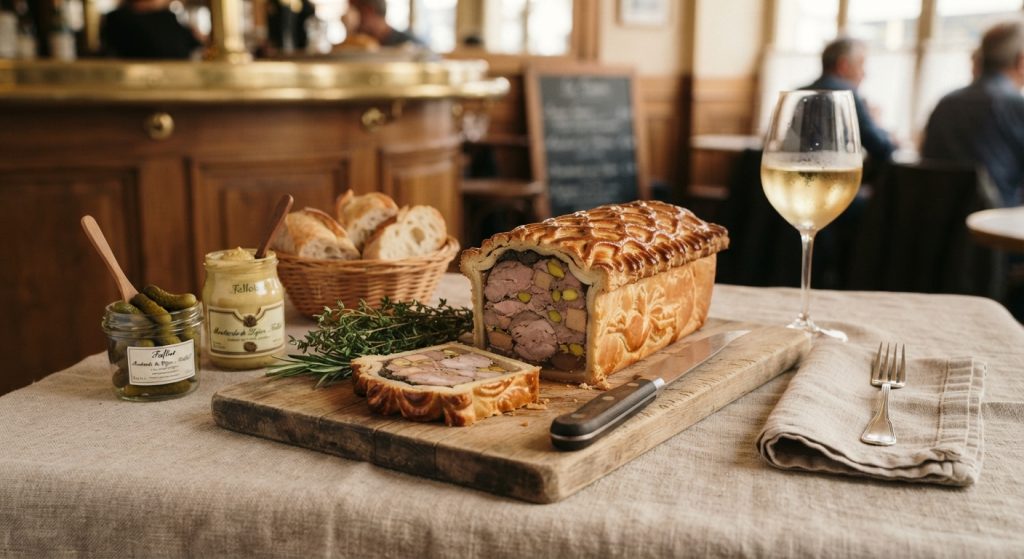
Simple accompaniments: Cornichons, a little mustard (ideally Dijon or old-style grain mustard), and good bread are the classic accompaniments. A simple green salad alongside is perfect.
Wine pairing: A rich, aromatic white wine works beautifully an Alsatian Gewurztraminer or” Pinot Gris”, a white Burgundy, or a “Côtes du Rhône”. For a game version, a light-to-medium red such as a “Pinot Noir” or a young “Côtes du Rhône rouge”.
Where to Find Pâté en Croûte
At an artisan charcutier: The best place to find a truly excellent pâté en croûte is at a quality artisan charcutier one who makes it in-house. Look for one that shows a well-defined, decorative cross-section when sliced. Ask when it was made: pâté en croûte is best eaten within 3-4 days of baking.
In Lyon: Lyon is arguably the world capital of pâté en croûte, with numerous charcutiers and bouchons (traditional Lyonnais bistros) offering excellent versions. If you visit Lyon, this is one preparation not to miss.
At specialist food shops: Good fromageries, épiceries fines (specialty food shops), and traiteurs (delicatessens) in major French cities often carry quality pâté en croûte, particularly around the holidays.
At home: If you are an ambitious cook, making a pâté en croûte at home is a supremely rewarding project. It requires a hinged terrine mold, patience, and several days but the result is extraordinary. There are excellent recipes in books dedicated to French charcuterie.
Pâté en Croûte vs. Other Pâtés: What’s the Difference?
| Preparation | Pastry Shell | Cooked in | Served |
|---|---|---|---|
| Pâté en croûte | Yes | In pastry mold | Sliced, cold |
| Terrine | No | In ceramic terrine | Sliced, cold |
| Pâté de campagne | No | In terrine or loaf tin | Sliced, cold |
| Ballotine | No (meat wrapping) | Poached or roasted | Sliced, hot or cold |
The defining characteristic of pâté en croûte is the pastry shell. Everything else — the filling, the garnish, the aspic can vary enormously.
Frequently Asked Questions
Is the pastry eaten?
Yes, absolutely. The pastry shell is an integral part of pâté en croûte, not just a container. A well-made crust is flavored by the cooking juices from the filling and should be eaten together with the meat and aspic.
How long does pâté en croûte keep?
Properly stored in the refrigerator, a pâté en croûte will keep for 4-5 days after cutting. Uncut, it may keep a day or two longer. It does not freeze well the aspic and pastry suffer significantly from freezing and thawing.
Can I make pâté en croûte at home?
Yes, but it requires time, planning, and the right equipment (primarily a hinged terrine mold). Allow at least two full days: one for preparation and assembly, one for baking and chilling before adding the aspic. A third day for the aspic to set fully. The result is spectacular and well worth the effort.
Why does my pâté en croûte have no aspic?
Some modern versions particularly those made for quick service skip the aspic entirely, relying on a well-seasoned, moist forcemeat to fill any gaps. While technically a pâté en croûte, the absence of aspic means it lacks the classic jewel-like appearance of a traditional version.
Final Thoughts
Pâté en croûte is, in many ways, the ultimate expression of the French charcutier’s art. It demands mastery of pastry, seasoning, texture, timing, and presentation all simultaneously. When it is done well, it is breathtaking: a slice that is as beautiful to look at as it is magnificent to eat.
In an era when so much food is made quickly and without visible craft, the pâté en croûte stands as a reminder of what happens when skill, time, and genuine passion for a tradition come together. It is a preparation worth seeking out, worth celebrating and, for the ambitious cook, worth attempting at home.
If you ever find yourself in a French charcuterie and see a pâté en croûte displayed in the window, do not walk past it. Buy a slice. It might well be one of the finest things you eat all year.