There is a moment when you taste truly exceptional boudin noir for the first time made by a master, from a pig slaughtered that morning, the blood still carrying warmth and you understand, perhaps for the first time, what the fuss is about. It is a deep, iron-rich, complex flavor that is unlike anything else in the entire world of charcuterie. It is primal and sophisticated at the same time. It is, in short, extraordinary.
I have devoted years to understanding “boudin noir”. I have tasted hundreds of versions across France, studied its history, visited the competitions, and spoken at length with the men and women who devote their professional lives to perfecting it. What I can tell you is this: boudin noir is one of the most underestimated, misunderstood, and frankly magnificent products in the entire French charcuterie tradition.
If you have been put off by the idea of blood sausage and I understand the instinct entirely I am here to change your mind.
What Exactly Is Boudin Noir?
Boudin noir is a cooked blood sausage. At its most basic, it consists of pig’s blood, pork fat, onions, salt, and spices, stuffed into a natural casing and cooked to set the filling. But this description does no justice whatsoever to the complexity of the product.
The blood and this cannot be overstated must be absolutely fresh. The moment blood leaves the living animal, biochemical changes begin that affect both flavor and texture. The greatest boudin noirs are made within hours of slaughter, with blood that has been carefully stirred to prevent coagulation and gently seasoned to begin the flavor development. An artisan charcutier who takes his craft seriously will often be at the abattoir at dawn to collect blood directly.
The fat typically lard from the pig’s cheek, back fat, or caul fat must also be fresh and of good quality. It is gently rendered and combined with finely diced or pureed onions that have been slowly cooked until completely soft and sweet. The ratio of blood to fat, and the type of fat used, vary enormously by region and charcutier, and these variations are the source of endless debate among enthusiasts.
The Ancient History of Boudin Noir
Blood sausage is one of the oldest processed foods in human history. References appear in the Odyssey Homer mentions a man tossing a stomach filled with fat and blood on a fire and Roman cookbooks record blood sausage recipes in elaborate detail. Apicius’ “De re coquinaria,” written in the 4th century AD, includes botellus blood sausage as a standard dish.
In France, the medieval guild system protected the right to produce boudin noir fiercely. The charcutiers’ guild established strict rules about quality, pricing, and the occasions on which boudin could be sold. The annual pig slaughter, typically in November or December when the cold weather aided preservation, was the central event of the charcuterie calendar, and boudin was always the first product made — a reward for the charcutier and his helpers, eaten warm within hours of production.
This tradition, the “tuaille” or “cochonnaille” depending on the region, persists in rural France today. I have been fortunate enough to participate in several traditional pig slaughters, and the communal preparation of boudin everyone standing around a large copper pot, stirring the blood, discussing the seasoning remains one of the most powerful experiences in French food culture.
The Art of Making “Boudin Noir”: What Separates the Great from the Good
Every serious charcutier has his own recipe for boudin noir, and most will guard it as jealously as a state secret. But across all the great boudins I have tasted, certain principles emerge:
Blood quality above all. The blood must come from healthy pigs, collected hygienically, and used as fresh as possible. Blood that has stood too long develops off-flavors that no amount of seasoning can mask.
The onion preparation. Onions must be cooked slowly and completely before incorporation. Undercooked onions leave harsh, sharp notes that clash with the mellow blood. Great charcutiers cook their onions for 40 to 60 minutes over very low heat until they are completely collapsed and meltingly sweet.
The seasoning balance. Salt, four-spice (quatre épices), and sometimes nutmeg, clove, or pepper must be in precise balance. Too much spice overpowers the blood; too little leaves the product flat and lifeless. This calibration takes years to master.
The cooking temperature. Boudin noir is cooked in water at around 80-85°C , never boiling. Boiling causes the casing to burst and the filling to dry out. The gentle heat allows the blood proteins to set slowly and evenly, producing the silky, slightly trembling texture of great boudin noir.
The Great Regional Boudins Noirs of France
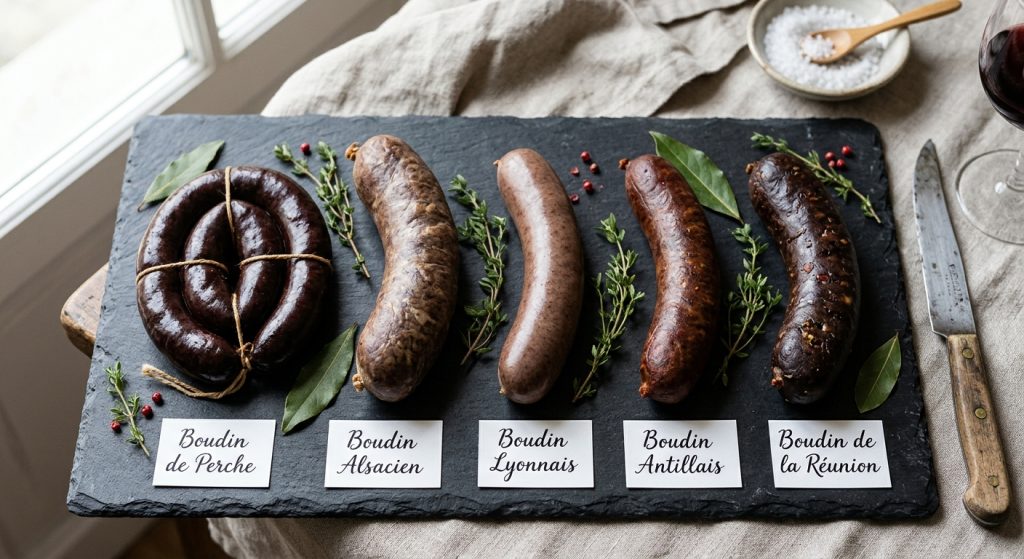
Boudin Noir du Perche , Normandie
The benchmark. Made with blood, onions, cream, and quatre épices. Relatively small in diameter, with a casing that splits satisfyingly when pressed. The flavor is clean, direct, and deeply satisfying , this is boudin at its most classical, allowing the quality of the blood and fat to speak without distraction. The best examples come from small artisan charcutiers in the Orne department.
Boudin Noir d’Auvergne
Auvergne’s version is notably more rustic and robust than the Percheron style. Often incorporating pieces of pork meat alongside the blood and fat, the Auvergnat boudin has a more pronounced meaty character. The seasoning is bolder, with more pepper and sometimes a hint of garlic. Eaten with a glass of Saint-Pourçain wine, it is the quintessential winter dish of the volcanic heartland of France.
Boudin Noir de Lyon
Lyon’s boudiniers , the specialists who dedicate themselves entirely to boudin production make a product of particular refinement. The Lyonnaise tradition incorporates cream and eggs alongside the blood, giving the sausage a luxurious, almost custard-like texture. It is more delicate than the northern styles, more subtle in flavor, but no less satisfying. Served in the city’s famous bouchons, it arrives simply cooked in butter with a tangle of caramelized onions.
Boudin Noir de la Réunion
The Réunionese boudin noir occupies an entirely different culinary world from its Metropolitan French counterparts. Seasoned with curry leaves, turmeric, ginger, and a blend of Indian Ocean spices, the Réunionese version is aromatic, warm, and vibrantly colored. It is typically served with rougail a tomato-based sauce with chillies and aromatics and eaten as part of the island’s famous “carri” tradition. This is boudin noir that would baffle a charcutier from Normandy, but it is French boudin nonetheless, and it is magnificent.
Boudin Antillais (Martinique & Guadeloupe)
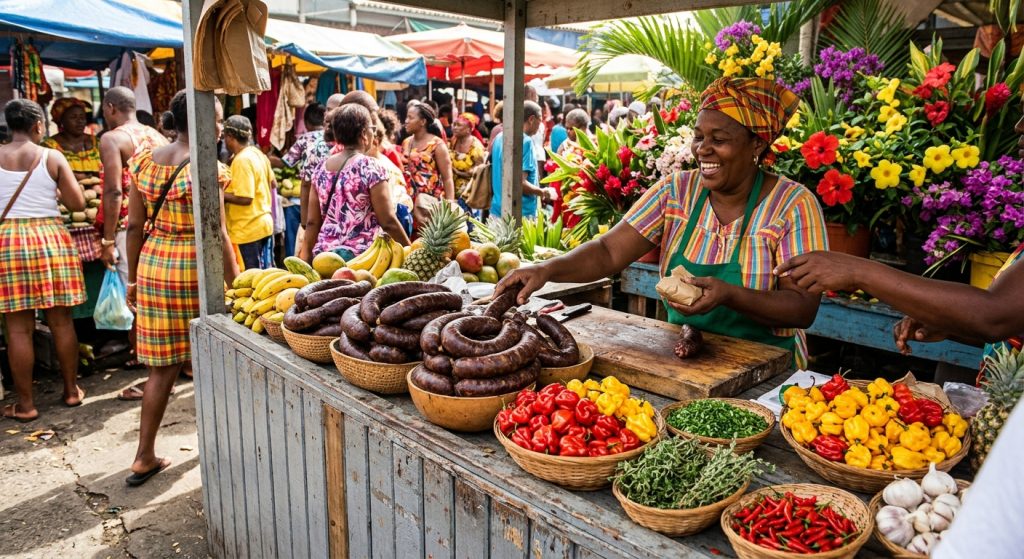
Boudin créole from the French Antilles is, in my opinion, the most exciting version of boudin noir produced anywhere under the French flag. The combination of high-quality pig’s blood with hot Caribbean peppers (particularly the bois-bossé and piment végétarien), fresh chives (cive), thyme, allspice (bois d’Inde), and cloves creates an explosion of flavor utterly unlike anything available in mainland France.
In Martinique, boudin is not a special occasion food it is everyday street food, sold warm from vendors at markets and festivals, eaten standing up with a piece of baguette or a piece of pain créole. The quality of Martiniquaise boudin, at its best, rivals anything produced by the finest charcutiers of Normandy. Different in every way, but equally exceptional.
The Competition Circuit: Where Boudin Noir Is Judged
Boudin noir has its own competitive world, and it is taken with complete seriousness by the artisans who enter it.
La Foire au Boudin de Mortagne-au-Perche
Held every March since 1963, this is the Olympics of boudin noir. Organized by the Confrérie des Chevaliers du Goûte-Boudin, the competition attracts entries from across France and increasingly from around the world. Winning a medal at Mortagne is the charcutier’s equivalent of a Michelin star for their boudin specifically it validates years of work and carries enormous commercial prestige. The judging panel evaluates appearance, texture, seasoning, aroma, and above all the indefinable quality of “blood freshness” that separates great boudin from merely good boudin.
Le Concours Général Agricole
France’s most prestigious agricultural competition, held annually at the Salon de l’Agriculture in Paris, includes charcuterie categories that cover boudin noir. A gold, silver, or bronze medal from the Concours Général Agricole is among the highest honors available in French food production. Winning producers display their medals prominently and reference them in their marketing for years afterwards.
The MOF (Meilleur Ouvrier de France)
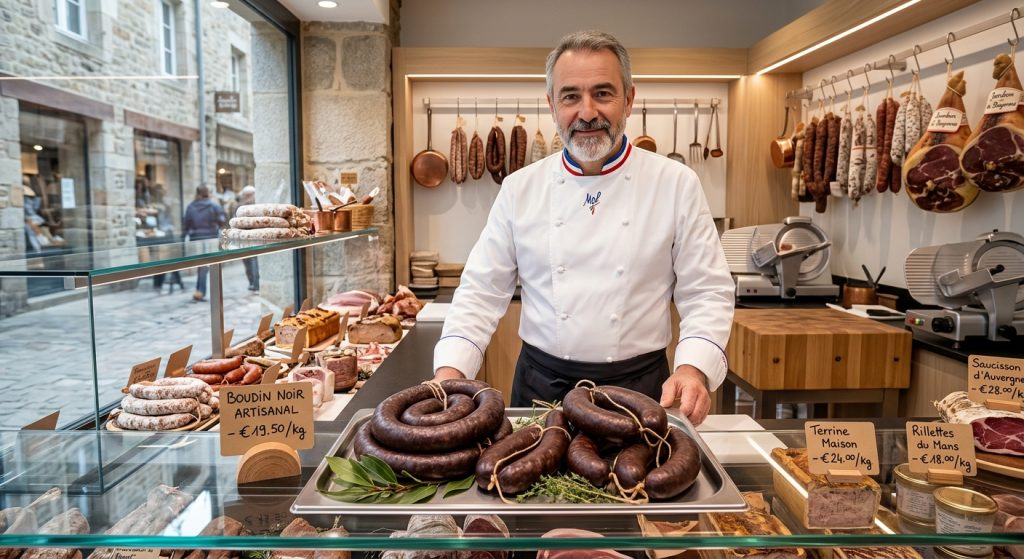
The “Meilleur Ouvrier de France” competition held every four years and covering dozens of craft disciplines includes charcuterie as one of its categories. An MOF charcutier has demonstrated mastery of the full range of charcuterie production, including boudin. The title, which allows the holder to wear the distinctive tricolor collar of their profession, is for life. It is the highest honor in French artisan food production, full stop.
How to Cook and Eat Boudin Noir Like a Frenchman
Boudin noir is sold pre-cooked but must be reheated before serving. The fundamental rule: gentle heat, never boiling. Here are the main preparation methods:
Pan-fried (Poêlé): Dry pan or with a tiny amount of butter, medium heat, 8-10 minutes, turning once or twice. The exterior should be slightly caramelized, the interior just heated through. This is the most common and in my view the best method.
Grilled (Grillé): On a hot grill or griddle, 5-6 minutes each side. The high heat creates a charred exterior that some enthusiasts prefer, though there is more risk of the casing splitting.
Oven-roasted (Au Four): At 180°C for 15-20 minutes. Less common but useful for large quantities.
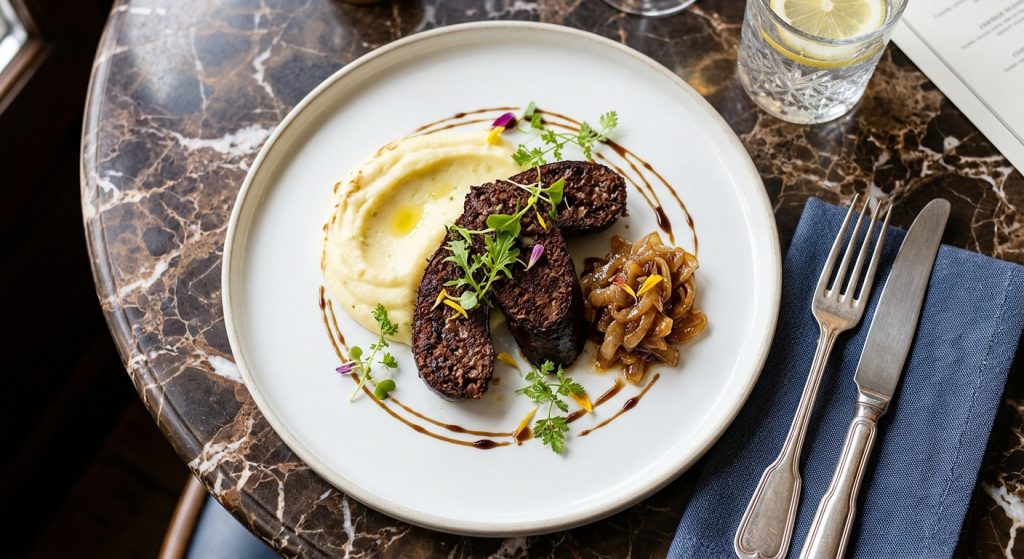
The classic accompaniments roasted apple, mashed potato, caramelized onions are not arbitrary. They are the result of centuries of refinement. The apple provides sweetness and acidity. The potato provides a neutral, starchy cushion. The onion provides depth and sweetness. Do not deviate until you have mastered the classic before experimenting.
My Verdict: Why Boudin Noir Is Essential
Boudin noir is not for everyone. I accept this. But for those willing to approach it with an open mind and preferably with a good artisan version as their first experience, not a supermarket industrial product it can be genuinely revelatory.
The depth of flavor that comes from high-quality blood, perfectly cooked onions, and generations of accumulated expertise is unlike anything else in the charcuterie world. It is honest food, direct food, food that makes no apologies and offers no shortcuts. In a culinary world that increasingly favors the processed, the sanitized, and the convenient, boudin noir stands as a magnificent rebuke and a testament to what French artisan food production can achieve when it is at its very best.
Seek it out. Cook it well. Eat it warm. You will not regret it.