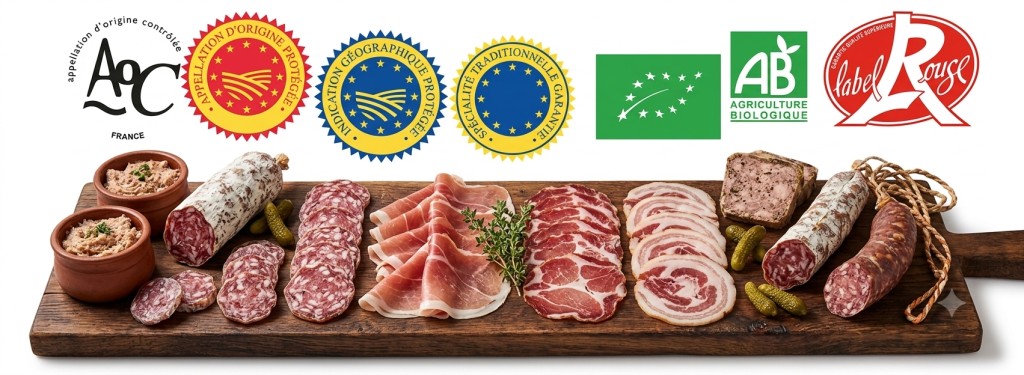
You’re standing in a French market, admiring a beautiful Jambon de Bayonne or a wheel of aged Comté — and you notice a small logo on the packaging: AOP, or IGP, or Label Rouge. But what do these labels actually mean? And why should you care?
These quality labels are not just marketing stickers. They are official European and French certifications that guarantee the origin, production methods, and quality of the product you’re buying. Understanding them is the key to buying the real thing — and avoiding inferior imitations.
In this guide, Pascal explains every quality label you’ll encounter on French charcuterie — clearly, simply, and with real examples.
Why Do Quality Labels Matter for Charcuterie?
French charcuterie has been copied and imitated around the world. A ‘Bayonne ham’ made in Argentina, a ‘saucisson de Lyon’ produced in a factory in Poland — without quality labels, it would be impossible for consumers to distinguish the authentic from the imitation.
Quality labels serve three essential purposes:
- They protect authentic producers from unfair competition.
- They guarantee consumers that what they’re buying is the real, traditional product.
- They preserve regional food traditions and local economies.
When you see one of these labels on a French charcuterie product, you can be confident that what you’re eating is authentic, traceable, and produced according to strict traditional standards.
The European Quality Labels (EU-Wide)
These labels are regulated at the European Union level and are recognized across all EU member states. You’ll see them on products from France, Italy, Spain, and beyond.
Protected Designation of Origin (PDO) / Appellation d’Origine Protégée (AOP)
The PDO (known as AOP in France) is the most stringent of all European quality labels. It guarantees that the product:
- Is produced, processed, AND prepared entirely within a specific geographical area.
- Has qualities or characteristics that are essentially due to that geographical environment (soil, climate, local know-how).
- Follows a strictly defined production method that cannot be modified.
In short: every single step of production must happen in the designated region. If even one step is done elsewhere, the product cannot carry the AOP label.
Examples in French charcuterie:
- Jambon de Bayonne AOP — produced exclusively in the Basque Country, with pigs raised and cured in the Adour basin.
- Saucisse de Morteau AOP — produced exclusively in the Franche-Comté region, smoked in traditional tuyés chimneys.
- Saucisse de Montbéliard AOP — similar to Morteau, from the same region.
- Jambon de Vendée AOP — from the Vendée region, with a distinctive gentle flavor.

Protected Geographical Indication (PGI) / Indication Géographique Protégée (IGP)
The PGI (IGP in French) is slightly less restrictive than the PDO/AOP, but still provides strong guarantees. It requires that at least one stage of production, processing, or preparation takes place in the defined geographical area.
The key difference from AOP: with IGP, the raw material (such as the pigs) doesn’t necessarily have to come from the same region — but a significant part of the production process must.
Examples in French charcuterie:
- Jambon de Bayonne IGP — (also holds AOP status, one of the few products with both).
- Jésus de Lyon IGP — produced in the Lyon region.
- Rosette de Lyon IGP — the famous large dry sausage from Lyon.
- Andouille de Guémené IGP — from Brittany, made from stacked rings of pork intestines.
- Jambon de l’Ardèche IGP — dry-cured ham from the Ardèche region.
Traditional Speciality Guaranteed (TSG) / Spécialité Traditionnelle Garantie (STG)
The TSG label is different from the others — it does not protect a geographical origin, but rather a traditional recipe or production method. A product can carry the TSG label regardless of where it is produced, as long as it follows the traditional recipe and method.
This label is less common in French charcuterie, but is found in other traditional European food products.
The French National Quality Labels
In addition to the European labels, France has its own national quality certifications that apply to products sold within France (and increasingly recognized internationally).
Full name: Appellation d’Origine Contrôlée (AOC)
The AOC is France’s oldest and most prestigious quality label, created in 1935 — originally for wines and spirits, then extended to food products. It is the founding label that inspired the entire European system of geographical indications.
The AOC guarantees that a product is produced, processed, and prepared entirely within a specific French geographical area, using a strictly defined traditional method. Every element — the breed of animals, the feed, the production technique, the aging method — is regulated.
AOC vs AOP — what’s the difference?
When France joined the European single market, the AOC label was extended at EU level under the name AOP (Appellation d’Origine Protégée). In practice, AOC and AOP carry the same guarantees — a product that holds the French AOC automatically qualifies for the European AOP. You will often see both mentioned together on packaging as ‘AOC/AOP’.
Examples in French charcuterie:
- Jambon de Bayonne AOC/AOP — produced exclusively in the Basque Country.
- Saucisse de Morteau AOC/AOP — smoked in traditional tuyés chimneys in Franche-Comté.
- Saucisse de Montbéliard AOC/AOP — from the same region as Morteau.
- Jambon de Vendée AOC/AOP — from the Vendée region.
Label Rouge — The French Quality Benchmark
Label Rouge (literally ‘Red Label’) is France’s oldest quality certification, created in 1960. It certifies that a product has significantly superior quality compared to similar products on the market.
To obtain the Label Rouge, a product must pass rigorous sensory (taste), physical, and chemical tests — and score significantly better than standard products in its category. An independent body verifies compliance annually.
What Label Rouge guarantees for charcuterie:
- Superior taste quality — confirmed by professional taste panels.
- Strict specifications on the origin and breed of the pigs.
- No artificial colorings, flavors, or preservatives beyond what is strictly necessary.
- Traceability from farm to shelf.
Examples: Jambon de Paris Label Rouge, Saucisson sec Label Rouge, Pâté de campagne Label Rouge.
AB — Agriculture Biologique (Organic)
The AB label (Agriculture Biologique) is France’s organic certification, equivalent to the EU Organic label. For charcuterie, it guarantees:
- Pigs raised on certified organic farms, with access to outdoor spaces.
- Feed made from at least 95% certified organic ingredients.
- No synthetic pesticides, hormones, or GMOs.
- Limited use of additives — no artificial preservatives or colorings.
- Regular independent inspections.
Organic charcuterie is a growing segment in France — look for the AB logo alongside standard charcuterie in supermarkets and specialty shops.

CCP — Certification de Conformité Produit
The CCP (Product Conformity Certification) is a mid-tier label that certifies a product meets a defined set of specifications — but without the strict geographical requirements of AOP/IGP or the superior quality threshold of Label Rouge. It’s essentially a ‘quality consistency’ guarantee.
Quick Comparison: Which Label Means What?
Here’s a simple way to remember the key labels:
- AOP/PDO = 100% from a specific French region, everything produced locally. The gold standard for origin.
- IGP/PGI = At least partly from a specific French region. Strong origin guarantee.
- Label Rouge = Superior taste quality, verified by blind tasting. The French quality benchmark.
- AB = Certified organic farming. Animal welfare and no synthetic inputs.
- CCP = Consistent quality to defined specs. A baseline guarantee.
Note: a product can hold multiple labels simultaneously. Jambon de Bayonne, for example, holds both AOP and IGP status. A Label Rouge saucisson can also be AB certified.
Practical Tips: How to Use Labels When Shopping
- Look for the label on the packaging — it should be clearly displayed as an official logo, not just text.
- In French markets, ask the vendor directly: ‘C’est AOP?’ — producers are proud of their labels and happy to explain.
- For the best quality: AOP or Label Rouge is your best guarantee.
- For ethical buying: look for AB (organic) alongside a quality label.
- Don’t be fooled by names alone: ‘Jambon façon Bayonne’ (Bayonne-style ham) is NOT the same as ‘Jambon de Bayonne AOP’. The word ‘façon’ (meaning ‘in the style of’) is a clear sign it’s not the real thing.
Frequently Asked Questions
What is the difference between AOP and IGP?
AOP (PDO) requires that every single stage of production takes place in the defined region — from raising the animals to the final product. IGP (PGI) only requires that at least one significant stage occurs in the region. AOP is therefore more restrictive and a stronger guarantee of true regional origin.
Are these labels available outside France?
Yes — AOP and IGP are European Union labels, legally recognized across all EU member states and in many countries that have trade agreements with the EU (including the UK post-Brexit, under a specific agreement). When you see PDO or PGI on a product sold internationally, it carries the same legal guarantee as AOP/IGP in France.
Does a Label Rouge product taste better than a non-labelled one?
By definition, yes — Label Rouge products must score significantly higher than comparable products in blind taste tests conducted by professional panels. The label is specifically designed to guarantee superior organoleptic (taste, texture, aroma) quality.
Final Thoughts
French quality labels are one of the most powerful tools a food lover has when shopping for authentic charcuterie. They represent decades — sometimes centuries — of tradition, regulation, and passionate defense of regional food heritage.
Next time you pick up a Jambon de Bayonne AOP or a Saucisse de Morteau AOP, you’ll know exactly what that small logo means — and why it matters. You’re not just buying a product. You’re buying a piece of French history.
https://agriculture.gouv.fr/official-labels-quality-and-origin
Pingback: Jambon Noir de Bigorre: France's Rarest and Most Prestigious Ham - French Cured Meats
Pingback: Rosette de Lyon: The Queen of French Dry Sausages - French Cured Meats
Pingback: How is Saucisson Sec Dried? The Complete Guide to French Dry-Curing - French Cured Meats